The global shift toward sustainable energy has placed India at the center of a massive industrial transition. As the nation strives to meet its ambitious goal of 500 GW of non-fossil fuel energy capacity by 2030, the Future of Windmill Tower Manufacturing in India has become a focal point for investors, engineers, and policymakers alike. No longer just a secondary component, the wind tower is evolving into a sophisticated piece of engineering designed to support larger turbines and endure harsher environments.
The wind energy sector is currently witnessing a paradigm shift. From the implementation of the Production Linked Incentive (PLI) schemes to the emergence of offshore wind projects, India is positioning itself as a global hub for renewable energy hardware. In this blog, we explore the technological advancements, market drivers, and strategic innovations shaping the wind tower industry.
The Rising Trajectory of Wind Energy in India
India currently ranks fourth globally in installed wind power capacity. However, the “low-hanging fruit” of high-wind sites has largely been tapped. The future of windmill tower manufacturing in India now lies in reaching higher altitudes where wind speeds are more consistent. This necessitates the production of taller, more resilient towers.
Manufacturers are moving away from standard tubular steel towers to hybrid models—combining concrete and steel—to reach heights of 140 meters and beyond. This evolution is not just about height; it is about localizing the supply chain to reduce costs and carbon footprints.
Key Trends Shaping the Future of Windmill Tower Manufacturing in India
1. Shift Toward Tall Hybrid Towers
As turbine capacities increase from 2MW to 5MW+, the structural demands on towers have intensified. Hybrid towers allow for greater stability and height, capturing stronger winds. This shift is driving demand for precision welding and heavy-duty fabrication capabilities.
2. The Offshore Wind Frontier
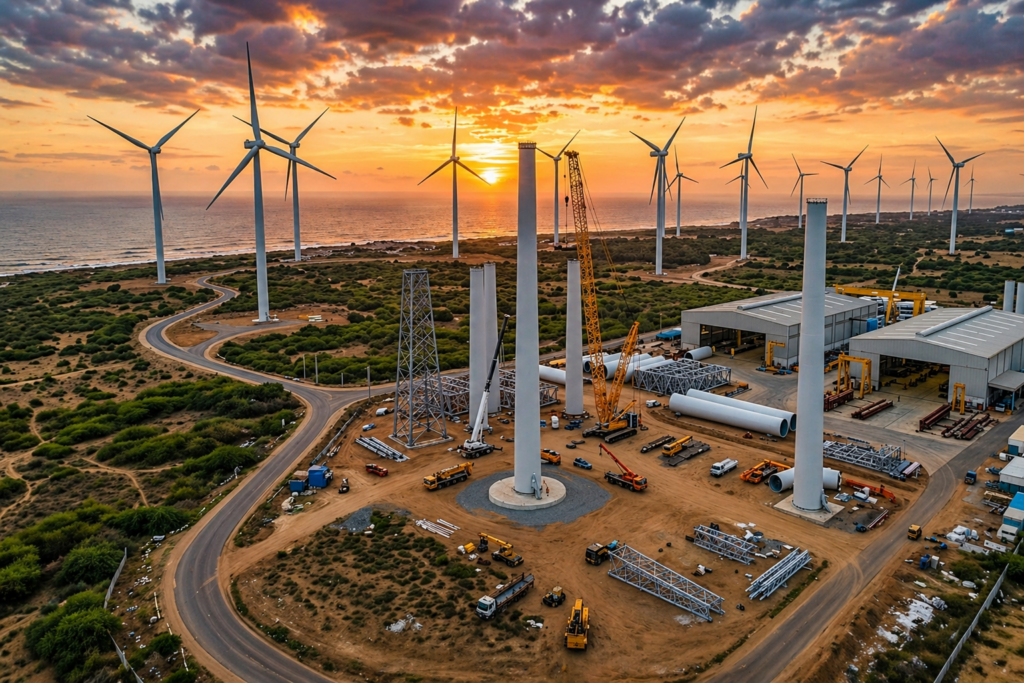
With a coastline spanning over 7,500 km, India’s offshore wind potential is staggering. Manufacturing towers for marine environments requires advanced anti-corrosive coatings and massive structural integrity. The future of windmill tower manufacturing in India will see dedicated coastal manufacturing clusters designed to ship these behemoths directly to sea.
3. Automation in Fabrication
Efficiency is the name of the game. Advanced CNC plate cutting machines and automated welding lines are replacing manual processes. This ensures zero-defect manufacturing and speeds up the “time-to-market” for large-scale IPP (Independent Power Provider) projects.
Government Policy: The Wind Beneath the Wings
The Indian government’s focus on “Atmanirbhar Bharat” has significantly boosted the future of windmill tower manufacturing in India. Policy interventions like the Inter-State Transmission System (ISTS) charges waiver for wind projects and the notification of the National Offshore Wind Energy Policy have created a predictable roadmap for manufacturers.
Furthermore, the Ministry of New and Renewable Energy (MNRE) is consistently bidding out capacities, ensuring a steady pipeline of work for fabrication units. According to recent reports by IRENA, India’s commitment to decarbonization is among the most transparent in the developing world, attracting significant Foreign Direct Investment (FDI).
Technical Challenges in Modern Tower Manufacturing
Manufacturing a wind tower is a feat of heavy engineering. It involves:
- Bending and Rolling: High-thickness steel plates must be rolled into perfect “cans.”
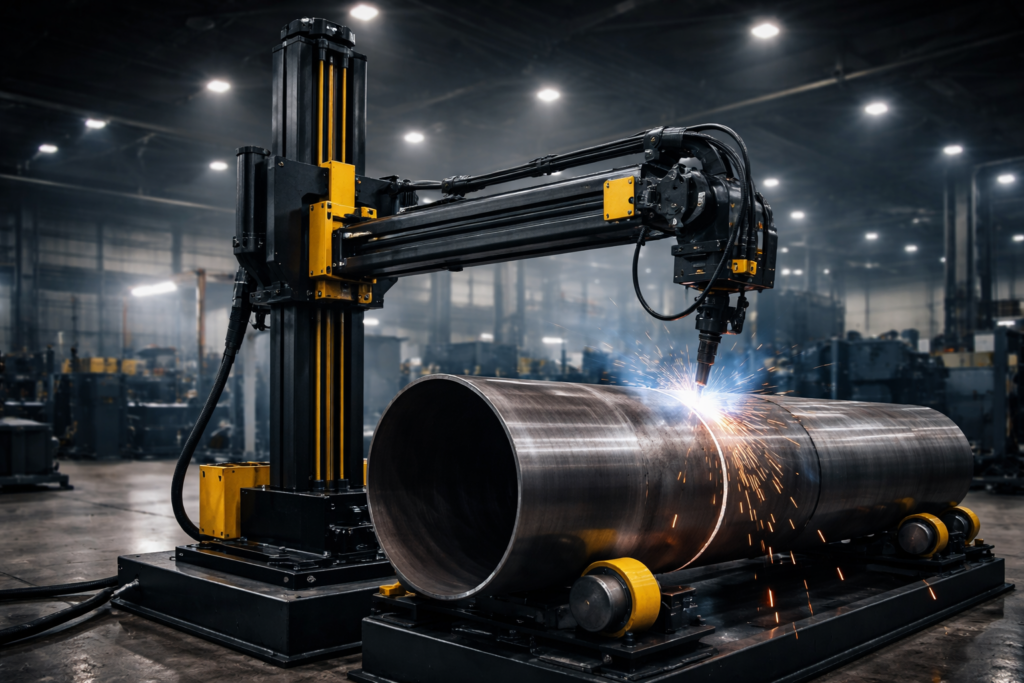
- Welding Integrity: Using Submerged Arc Welding (SAW) to ensure joints can withstand decades of vibration.
- Logistics: Transporting 30-meter sections across Indian highways requires specialized modular trailers and meticulous route planning.
To address these challenges, companies are adopting Heavy Duty Column and Boom systems that allow for seamless welding of large-diameter cylinders.
The Role of CuBuilt in the Wind Energy Ecosystem
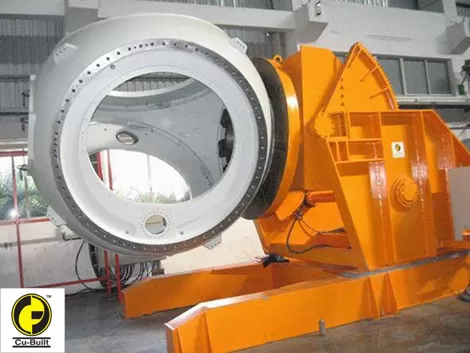
At CuBuilt, we understand that the future of windmill tower manufacturing in India depends on the quality of the machinery used in the fabrication process. We provide the heavy-duty infrastructure that allows manufacturers to scale their operations.
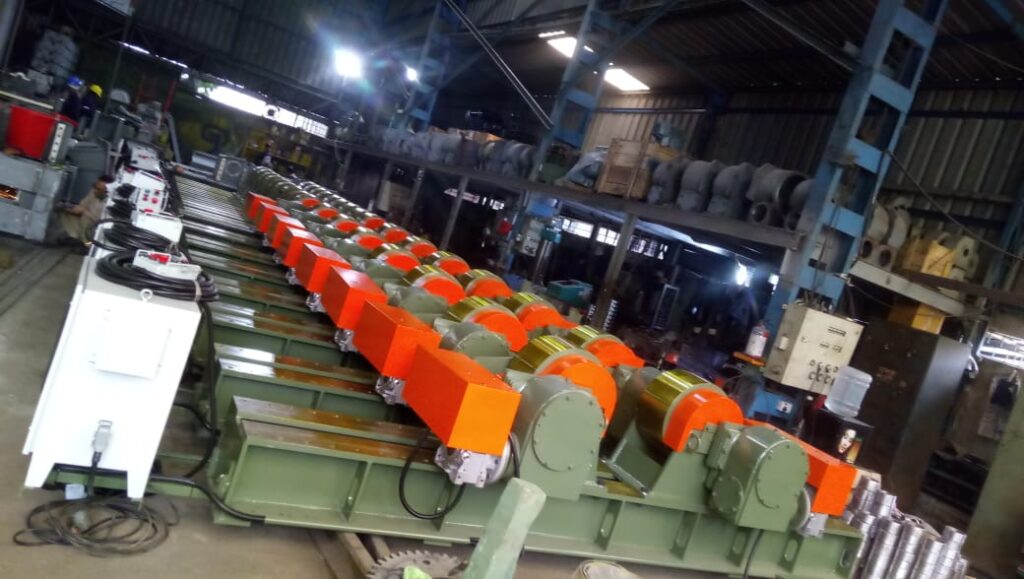
Our Rotators and Rollers are designed to handle the massive weights of modern turbine towers, ensuring precise rotation for high-quality welding seams. By providing world-class fabrication equipment, we enable Indian manufacturers to compete on a global stage, ensuring that “Made in India” wind towers are installed from the North Sea to the Australian Outback.
Sustainability in Manufacturing
The irony of building green energy components in a high-pollution factory is not lost on the industry. The future of windmill tower manufacturing in India involves adopting “Green Steel” and energy-efficient fabrication processes. Reducing scrap through optimized CNC nesting and using solar-powered welding units are becoming industry standards.
Economic Impact and Job Creation
The expansion of wind tower plants is a massive job creator. From specialized welders and NDT (Non-Destructive Testing) technicians to logistics experts and structural engineers, the sector is revitalizing industrial hubs in states like Gujarat, Maharashtra, and Tamil Nadu. As per data from Global Wind Energy Council (GWEC), every megawatt of wind energy installed creates nearly 30 job-years of employment across the value chain.
Future Outlook: 2026 and Beyond
By 2026, we expect to see the first major offshore foundations being laid in the Gulf of Khambhat. This will require a completely different scale of manufacturing. The future of windmill tower manufacturing in India will be characterized by:
- Digital Twins: Using IoT to monitor the structural health of towers in real-time.
- Modular Construction: Towers that can be bolted together on-site to bypass transport limitations.
- Advanced Material Science: Explorations into carbon-fiber-reinforced towers for extreme heights.
Partner with CuBuilt for Excellence in Fabrication
As the wind energy sector grows, the demand for precision, durability, and scale will only increase. Whether you are setting up a new fabrication unit or upgrading an existing line to meet the demands of the future of windmill tower manufacturing in India, CuBuilt is your strategic partner. Our range of automated welding and cutting solutions is engineered to deliver the performance required for the next generation of renewable energy infrastructure.
Contact CuBuilt today to explore our heavy-duty fabrication solutions and lead the Indian wind revolution.
Frequently Asked Questions (Q&A)
Q1: What is the average height of a windmill tower in India?
Currently, most towers range between 80 to 120 meters. However, the trend is moving toward 140-160 meters to capture higher wind speeds.
Q2: Why is the “Make in India” initiative important for wind towers?
It reduces the cost of logistics, which can account for up to 20% of the total tower cost, and ensures that the infrastructure is built to suit local climatic conditions.
Q3: What materials are used in the future of windmill tower manufacturing in India?
While S355 grade steel remains the standard, we are seeing a rise in high-strength concrete for hybrid towers and advanced coatings for offshore applications.
Q4: How does CuBuilt support the wind energy sector?
We manufacture and supply the heavy-duty machinery—such as welding rotators, column and boom systems, and CNC cutting machines—required to fabricate large-scale wind towers efficiently.
Q5: What is the lifespan of a modern wind tower?
A well-manufactured tower is designed to last 20 to 25 years, though with modern anti-corrosive treatments and structural monitoring, this can be extended.