Every year, fabrication shops and heavy manufacturing plants lose thousands of hours — and lakhs of rupees — because they bought the wrong welding rotator for their job.
A rotator that can’t handle your workpiece geometry. A drive system that slips under load. Rollers that mark the surface of pressure vessels. These are not small problems — they cause weld defects, rework cycles, project delays, and in some cases, safety incidents.
The good news? With the right knowledge, choosing a welding rotator is straightforward.
Whether you are fabricating pressure vessels, wind towers, storage tanks, heat exchangers, or large-bore pipework, this complete buyer’s guide walks you through every factor that determines the right welding rotator for your application — load capacity, roller type, drive configuration, and more.
Let’s start from the beginning.
What Is a Welding Rotator and How Does It Work?
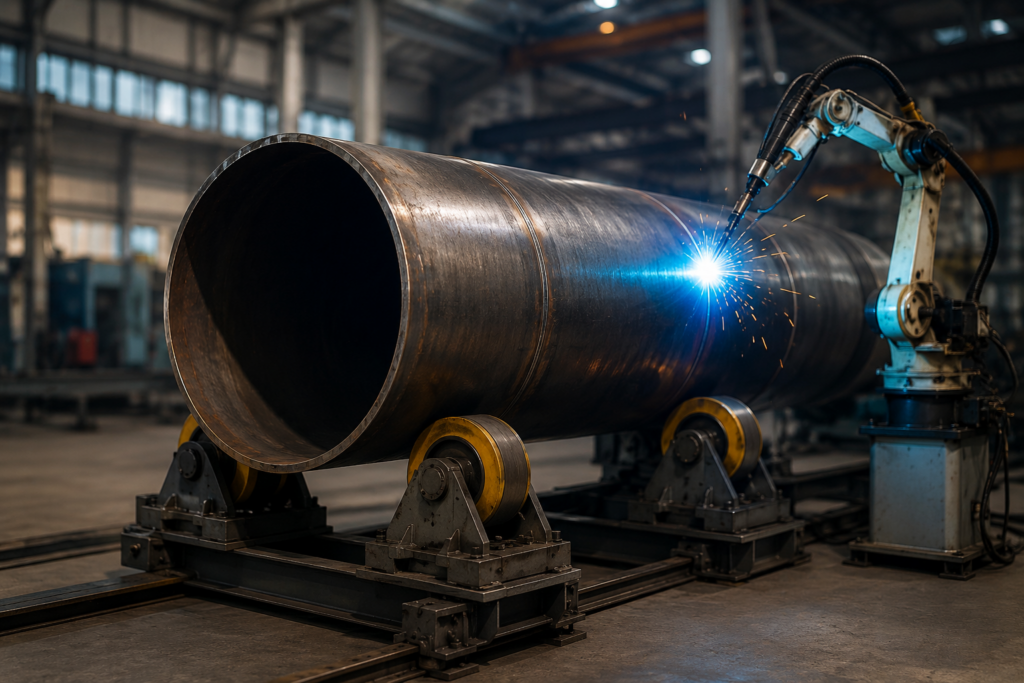
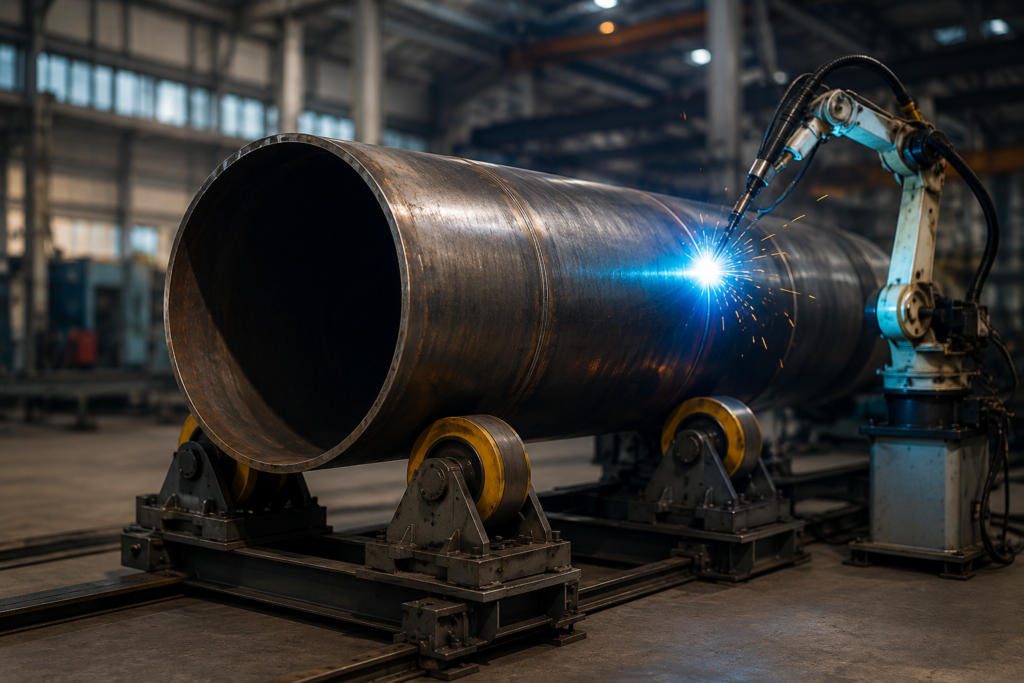
A welding rotator (also called a tank turning roll or pipe rotator) is a piece of welding automation equipment designed to rotate cylindrical workpieces — such as pipes, pressure vessels, tanks, and boilers — at a controlled speed during the welding process.
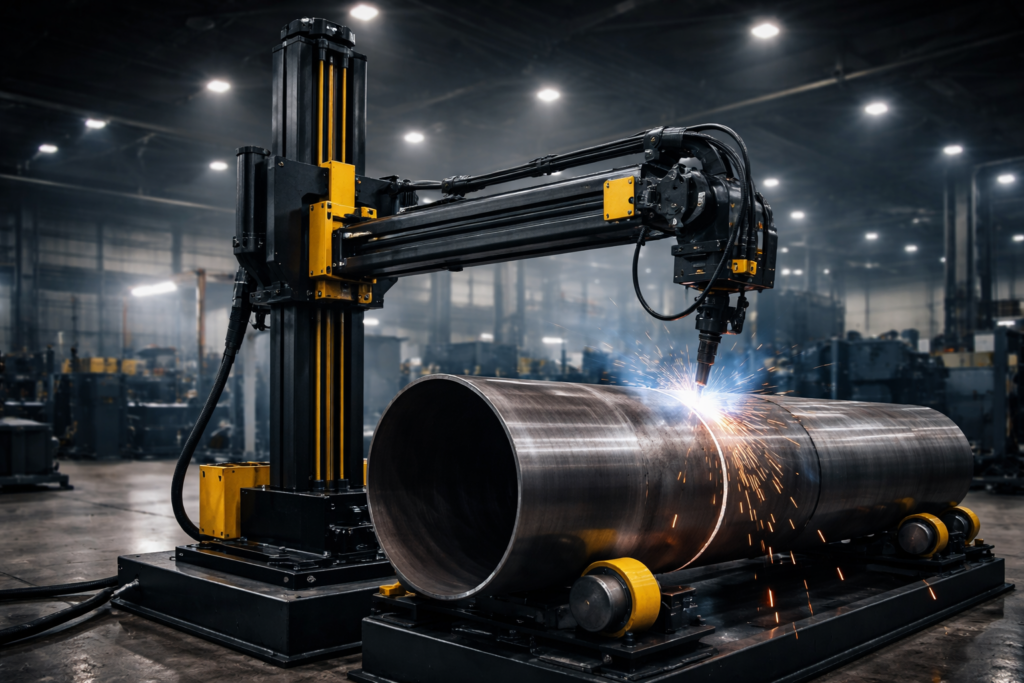
Instead of the welder or robot moving around the workpiece, the rotator turns the part beneath a fixed welding torch. This delivers:
- Consistent weld quality — the torch stays in the optimal flat (1G) position throughout
- Faster travel speeds — automated rotation eliminates manual repositioning stops
- Reduced operator fatigue — welders monitor rather than physically manipulate heavy components
- Lower distortion — controlled, consistent heat input reduces thermal warping
According to the American Welding Society (AWS), positioning equipment like welding rotators can improve weld quality consistency by up to 30% compared to manual positional welding — a significant gain in heavy fabrication environments.
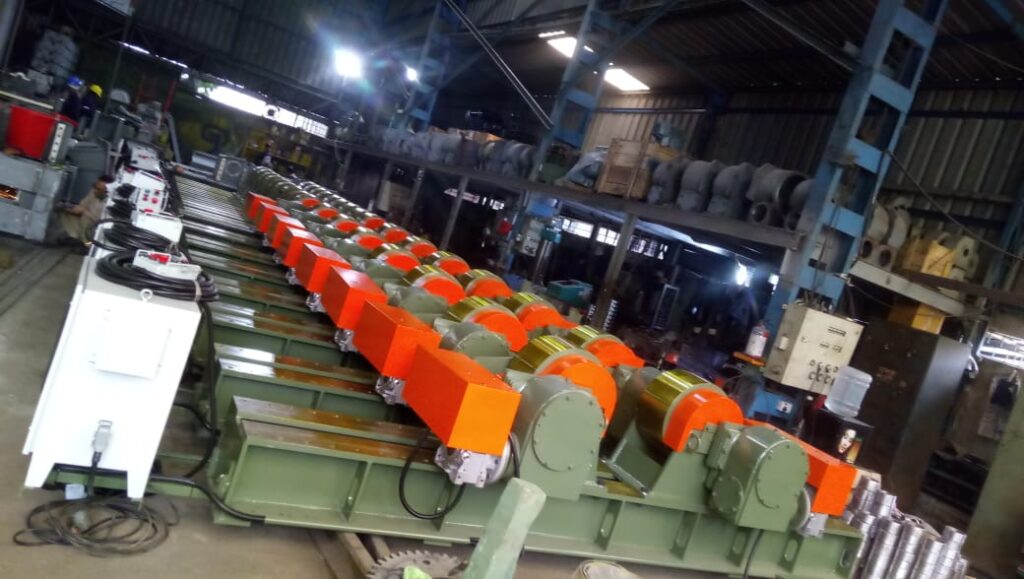
The basic setup consists of drive rolls (powered, to rotate the workpiece) and idle rolls (unpowered, to support and stabilize). More advanced systems add hydraulic adjustment, anti-creep controls, and integrated PLC speed control.
The 7 Main Types of Welding Rotators — And When to Use Each One
1. Conventional Type Welding Rotators
The most widely used rotator in general fabrication. Conventional rotators have fixed-width roller frames and are best suited for workpieces with consistent diameters.
Best for: Storage tanks, standard pipe spools, boilers, rollers with predictable OD ranges
Capacity: Typically 5 tonnes to 300 tonnes
Key advantage: Simple operation, low maintenance, cost-effective
�� Explore Cu-Built’s Conventional Type Welding Rotators
2. Self-Aligning Welding Rotators
Self-aligning rotators automatically adjust roller angles to match the diameter and weight of the workpiece — no manual adjustment needed. The rollers pivot to cradle the part correctly every time.
Best for: Fabrication shops handling multiple vessel sizes; pressure vessel OEMs; job shops
Capacity: 5 tonnes to 1,000+ tonnes
Key advantage: Faster setup, less operator skill required, safer for irregular or tapered shells
This is one of the most popular rotator types in India’s growing pressure vessel and oil & gas fabrication sector.
�� See Cu-Built’s Self-Aligning Welding Rotators
3. Self-Centering Type Welding Rotators
A more advanced variant where rollers automatically center the workpiece along the longitudinal axis. This is critical for applications where precise weld seam tracking is required.
Best for: Large-diameter vessels, wind tower can sections, pipeline components
Key advantage: Eliminates lateral drift during rotation — especially important with SAW (Submerged Arc Welding) processes
4. Pipe Welding Rotators
Designed specifically for the dimensions and weights of pipe fabrication. These rotators have a narrower frame width and are optimized for smaller OD ranges typically found in piping work.
Best for: Pipe spooling shops, EPC contractors, oil & gas maintenance facilities
Common OD range: 50mm to 2,000mm
�� View Cu-Built’s Pipe Welding Rotators
5. Hydraulic Shell-to-Shell Fit-Up Rotators
These are specialized rotators used to align and fit-up two shell sections before welding begins — a critical step in multi-can vessel manufacturing. The hydraulic system precisely controls end-to-end alignment.
Best for: Pressure vessel manufacturers, wind tower fabricators, storage tank plants
Key advantage: Eliminates manual fit-up — dramatically reduces the time between shell rolling and first weld pass
6. Stand Welding Rotators
Stand rotators are elevated systems used when the workpiece needs to be positioned at a greater working height — for example, when welding long horizontal vessels on a production line where material handling equipment operates underneath.
Best for: Industrial production lines, shipyards, heavy equipment OEMs
7. Blasting and Painting Rotators
These are rotators designed not for welding, but for surface preparation and coating. They rotate vessels slowly and uniformly during shot blasting, grit blasting, or paint application — ensuring full 360° coverage.
Best for: Pre-treatment shops, tank manufacturers, pressure vessel surface finishing
5 Critical Factors When Selecting a Welding Rotator
Before you raise a purchase order, your selection must be based on these five engineering parameters:
1. Maximum Load Capacity (tonnes)
This is non-negotiable. Always select a rotator rated for at least 20% above your heaviest anticipated workpiece — this buffer accounts for eccentric loads, dynamic forces during startup, and future production growth. Never operate a rotator at 100% of nameplate capacity.
2. Workpiece Diameter Range (OD)
Each rotator model has a minimum and maximum OD it can safely support. Self-aligning rotators offer the widest range. Conventional rotators require manual resetting when the OD changes significantly. Confirm the OD range covers your full product mix, not just today’s largest part.
3. Rotation Speed Range (RPM / mm per minute)
Welding processes have very different travel speed requirements:
- SAW (Submerged Arc Welding): 100–600 mm/min typical
- MIG/MAG: 200–1,200 mm/min typical
- TIG: 50–300 mm/min typical
Your rotator must deliver consistent, variable speed across the required range without hunting or slippage — particularly critical when welding with automated torch carriages.
4. Roller Material and Surface
- Polyurethane rollers: Best for thin-wall vessels and pipes — soft contact prevents surface marking
- Steel rollers: Suited for heavy structural components where surface condition is less critical
- Steel rollers with polyurethane rings: The most versatile combination for mixed production
5. Anti-Creep / Anti-Drift Control
Heavy workpieces tend to “walk” axially during rotation due to slight misalignment or taper. A quality welding rotator must include an anti-creep mechanism — either mechanical angling of the drive rolls or electronic correction via PLC — to keep the seam under the torch.
According to Lincoln Electric’s automation guidelines, axial drift control is one of the top three reasons fabricators experience failed automated welds on rotators.
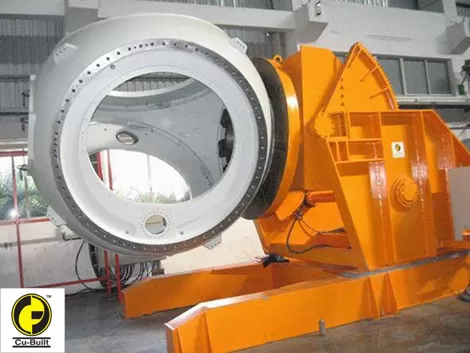
Welding Rotator vs Welding Positioner — What’s the Difference?
This is one of the most commonly asked questions in fabrication shops:
| Feature | Welding Rotator | Welding Positioner |
| Best for | Cylindrical parts (pipes, vessels) | Irregular or smaller assemblies |
| Motion | Continuous rotation | Tilt + rotation (2-axis) |
| Typical workpiece | Tanks, boilers, towers | Flanges, brackets, small fabrications |
| Weight range | 5T to 1,000T+ | 0.5T to 200T |
| Integration | Works with column & boom | Works standalone or with boom |
For large cylindrical work, rotators are almost always the right choice. For complex, multi-joint assemblies, a positioner gives you the angular flexibility you need.
How Cu-Built Engineers Selects the Right Rotator for Your Application
At Cu-Built Engineers, the rotator selection process starts before any commercial discussion. The engineering team evaluates:
- Maximum vessel OD and length
- Material type and wall thickness (to determine surface contact requirements)
- Welding process and target travel speed
- Production volume and duty cycle
- Integration with column & boom or automated torch systems
- Floor space and workshop layout constraints
This application engineering approach — rather than a catalog-based sale — is what ensures the right equipment lands in your facility.
Cu-Built manufactures welding rotators from 5 tonnes to 1,000 tonnes capacity, with options including self-aligning, conventional, hydraulic fit-up, pipe-specific, and custom configurations across plants in Pune, Satara, Karnataka, and Gujarat.
Common Mistakes to Avoid When Buying a Welding Rotator
- Buying on price alone — A cheaper rotator with poor speed control will cost you in rework and downtime within 12 months.
- Ignoring OD range flexibility — Always think about your 3-year product roadmap, not just today’s job.
- Skipping anti-creep specifications — Essential for SAW automation. Non-negotiable.
- Overlooking after-sales support — Spare rollers, drive units, and PLC support must be locally available.
- Not integrating with your column & boom — A rotator works best as part of a coordinated welding station, not in isolation.
Ready to Choose the Right Welding Rotator? Talk to Our Engineers.
Choosing a welding rotator is not just a procurement decision — it’s a production engineering decision that affects your quality, throughput, and operating costs for the next 10–15 years.
Cu-Built Engineers has designed and delivered welding automation systems for India’s leading vessel manufacturers, wind tower fabricators, and EPC contractors — including Adani, Enercon, and ReNew Power.
Get expert guidance, a detailed technical proposal, and competitive pricing within 48 hours.
�� Contact Cu-Built Engineers — Get a Free Technical Consultation
�� +91 97300 89705
�� sales@cubuilt.com
�� MIDC Bhosari, Pune, Maharashtra
Also explore: