Selecting the correct eot crane system is one of the most vital capital investment decisions for any industrial facility, manufacturing workshop, or warehousing hub. Electric overhead traveling cranes form the backbone of modern material handling. They ensure smooth material movement, optimize floor utilization, and protect workers from dangerous manual lifting hazards. However, when designing a plant layout or upgrading an existing bay, plant managers and procurement teams face a critical choice: should you install a single girder setup or invest in a double girder architecture?
Choosing the wrong configuration can lead to structural bottlenecks, reduced lifting height, overspent capital budgets, or inadequate load capacity. Both crane variants serve distinct operational purposes, carrying unique engineering profiles, structural load characteristics, and budget implications.
This detailed technical guide breaks down the core structural differences, engineering mechanics, headroom parameters, and total cost of ownership between single girder and double girder overhead systems. Whether you manage a light assembly unit, a heavy vessel fabrication bay, or an automated storage yard, this comparison will help you identify the precise lifting infrastructure required to optimize your production throughput.
What Is an EOT Crane and How Does It Function?
An eot crane (Electric Overhead Traveling Crane) is an overhead material handling machine designed to lift, lower, and transport heavy loads horizontally across the length and width of an industrial building. The crane operates along elevated runway beams that are mounted on structural building columns or dedicated gantry structures.
The primary machinery assembly consists of three core movement axes:
- Bridge Motion (Long Travel): The main structural bridge moves longitudinally down the length of the building bay on end carriages attached to elevated rails.
- Trolley Motion (Cross Travel): A motorized trolley moves transversely across the bridge span, carrying the hoist assembly from side to side.
- Hoist Motion (Vertical Lift): An electric wire rope or chain mechanism raises and lowers the load hook vertically.
By coordinating these three dimensions, an overhead crane system covers the entire 3D envelope of a factory floor, eliminating floor obstructions and streamlining internal logistics.
Anatomy of an EOT Crane: Core Components
Understanding the mechanical anatomy of an eot crane helps clarify why girder design fundamentally alters crane performance.
- Bridge Girder: The main horizontal beam or pair of beams spanning the width of the factory bay. Girders are manufactured either as standard rolled steel I-beams for lighter duties or fabricated box girders for heavy-duty spans.
- End Carriages: Fabricated steel structures located at both ends of the bridge girder housing wheels, bearings, and drive motors that travel along the runway rails.
- Trolley Assembly: The cross-travel carriage that supports the hoisting gear.
- Trolley Hoist Mechanism: The motor, gearbox, brake, drum, wire rope, and load hook block configured to deliver controlled mechanical advantage during lifting operations.
- Runway Rails: Heavy-steel rails installed along the building columns on top of crane runway beams.
- Electrical Controls: Variable Frequency Drives (VFDs), pendant controllers, radio remote control systems, and protective control panels.
Understanding the Single Girder EOT Crane
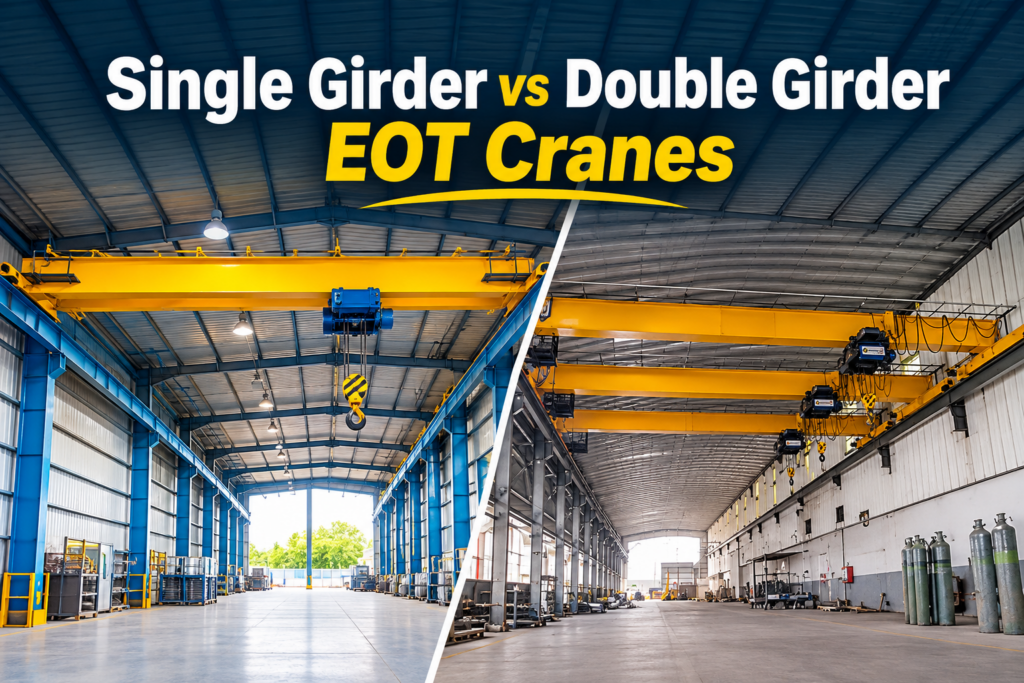
A single girder eot crane utilizes a single main bridge beam supported by two end carriages. In this configuration, the hoisting mechanism typically hangs below the main girder on an underslung trolley that travels along the bottom flange of the beam.
Key Engineering Features
- Structural Design: Uses a single rolled profile or box beam.
- Trolley Mounting: Underslung configuration where the trolley rides on the lower flange of the bridge beam.
- Load Capacity Range: Typically designed for capacities up to 20 tonnes.
- Standard Span Coverage: Ideal for bay widths up to 20 meters.
Typical Applications
Single girder designs are widely implemented in light-to-medium manufacturing environments, tool rooms, warehousing facilities, assembly lines, and maintenance bays. If your production workflow demands intermittent lifting without continuous duty cycle stress, this option offers an optimal balance of strength and cost-efficiency.
To explore customized single-girder configurations built to rigorous standards, browse the Cu-Built Single Girder EOT Cranes Lineup.
Understanding the Double Girder EOT Crane
A double girder eot crane features two parallel bridge girders mounted onto end carriages. Instead of hanging below the beam, a top-running crab trolley travels along rails welded directly to the top covers of the dual girders.
Key Engineering Features
- Structural Design: Dual torsion-free box-type girders offering high rigidity.
- Trolley Mounting: Top-running crab unit traveling on rails mounted to top flanges.
- Load Capacity Range: Typically starts at 5 tonnes and extends up to 500+ tonnes.
- Standard Span Coverage: Easily handles spans exceeding 25 to 30+ meters.
Typical Applications
Double girder overhead systems are engineered for severe operating environments, continuous duty cycles (Class M5 to M8), and high-capacity manufacturing setups. You will find these heavy-duty units in steel mills, vessel fabrication facilities, heavy equipment assembly lines, power plants, and foundry shops.
For heavy-duty plant requirements, examine high-tonnage lifting options via the Cu-Built Double Girder EOT Cranes Product Range.
Detailed Comparison: Single Girder vs. Double Girder EOT Crane Systems
To evaluate which crane configuration fits your operational criteria, review this direct feature-by-feature breakdown:
| Technical & Operational Parameter | Single Girder EOT Crane | Double Girder EOT Crane |
| Number of Main Bridge Beams | 1 Bridge Beam | 2 Parallel Bridge Beams |
| Lifting Capacity Limits | Up to 20 Tonnes | 5 Tonnes to 500+ Tonnes |
| Maximum Operational Span | Up to 20 Meters | 30+ Meters |
| Trolley & Hoist Configuration | Underslung (Trolley hangs on bottom flange) | Top-Running Crab (Trolley rides on top rails) |
| Hook Height / Headroom Efficiency | Lower (Hoist hangs under the beam) | Maximum (Hook pulls up between dual girders) |
| Dead Weight / Wheel Loading | Lower dead weight, lighter wheel load | Higher dead weight, heavier structural load |
| Capital & Installation Cost | Highly economical (20-30% lower cost) | Higher initial investment requirement |
| Maintenance Accessibility | Requires ladders or mobile platforms | Walkway and maintenance platform integrated |
| Duty Cycle Classification | Light to Medium Duty (M1 to M4) | Heavy to Severe Duty (M5 to M8) |
Technical Evaluation Factors for Facility Managers
When deciding on an eot crane setup for your factory, engineering teams must evaluate six core technical parameters.
1. Load Capacity and Duty Cycle Requirements
The primary governing factor for crane selection is maximum Safe Working Load (SWL) and duty cycle frequency. If your maximum load is under 15 tonnes and operations run on single shifts, a single girder configuration is usually sufficient. However, if your operations involve constant lifting of 20+ tonnes in multi-shift schedules, the dual-girder architecture offers superior fatigue resistance and long-term structural integrity.
2. Headroom and Maximum Hook Height
Hook clearance dictates how high you can lift products inside your building. In low-headroom facilities, a single girder underslung hoist reduces vertical clearance because the entire hoist mechanism sits below the main girder line. Conversely, on a double girder crane, the hoist sits on top of the girders. This allows the hook to travel upward into the space between the two beams, gaining vital vertical lift height without increasing roof elevation.
3. Structural Dead Weight and Building Foundation Loads
Every overhead crane exerts dynamic wheel loads onto runway beams and factory columns. Single girder cranes exert significantly lower dead weight, reducing civil foundation engineering requirements and building steel costs. Installing a heavy double girder crane into an existing structure may require retrofitting building columns to withstand higher wheel reactions.
5. Maintenance Access and Operations
Maintaining an underslung trolley on a single girder crane often requires scissor lifts, scaffolding, or mobile platforms. In contrast, double girder cranes can be outfitted with full-length steel walkways, handrails, and maintenance platforms alongside the bridge girders. This allows technicians to inspect motors, brakes, and electrical panels safely.
6. Auxiliary Hoists and Special Attachments
If your manufacturing process requires secondary auxiliary hoists for turning fabricated assemblies, or specialized attachments like magnetic lifters, motor-operated grabs, or ladle hooks, a double girder platform is mandatory. Dual girders provide the structural foundation needed to mount complex multi-hoist crab frames.
Financial Analysis: Initial Investment vs. Total Cost of Ownership
Choosing an eot crane involves balancing initial capital expenditure (CapEx) against long-term operational expenses (OpEx).
- Capital Investment (CapEx): Single girder cranes require less steel, smaller motor drive packages, and lighter end carriages, making them 20% to 30% less expensive than double girder equivalents of the same span.
- Civil Infrastructure Costs: Lower dead weight allows for lighter runway beams and standard building columns, generating savings on new facility builds.
- Long-Term Operational Expenses (OpEx): In heavy-duty or continuous-production environments, operating a single girder crane near its mechanical capacity can accelerate wheel wear, flange friction, and motor fatigue. A heavy-duty double girder crane minimizes structural flexing, extending equipment service life to 20–30 years with lower maintenance downtime.
To evaluate structural alternatives like outdoor yard gantries or column-free lifting setups, refer to the detailed Cu-Built EOT Crane vs Gantry Crane Guide.
Safety Standards and Industry Compliance
Industrial overhead crane design in India is governed by strict structural and mechanical safety frameworks. When sourcing material handling machinery, verify that your engineering supplier designs equipment in accordance with key industry standards:
- IS 3177: Code of practice for electric overhead traveling cranes and gantry cranes regarding mechanical, structural, and electrical design rules.
- IS 807: Structural steel design code for crane structures, establishing allowable stress limits, wind loads, and deflection criteria.
- CMAA Specifications (Class A through F): Crane Manufacturers Association of America standards governing duty classifications based on load cycles and environmental severity.
- ISO / FEM Standards: International criteria regulating gear design, bearing life calculation, and motor selection for optimized reliability.
For technical compliance resources, refer to structural engineering guidelines published by the Bureau of Indian Standards (BIS) and mechanical design standards maintained by the Crane Manufacturers Association of America (CMAA).
Modern industrial cranes are equipped with essential safety features, including:
- Dual-stage limit switches for hoisting, cross travel, and long travel.
- Variable Frequency Drives (VFDs) for smooth acceleration/deceleration, eliminating load swing.
- Overload limiters to automatically halt lifting when safety thresholds are exceeded.
- Emergency stop circuits and wireless radio remote control systems.
Customizing Material Handling Systems for Plant Efficiency
Overhead cranes frequently work alongside other heavy automation and material movement equipment. In modern manufacturing plants, material handling efficiency relies on integrating multiple specialized systems:
- Motorized Transfer Trolleys: Used to transport heavy fabricated components, steel coils, and dies between building bays.
- Jib Cranes & Underslung Units: Provide localized lifting at dedicated workstations, freeing up the primary EOT crane for main-line transport.
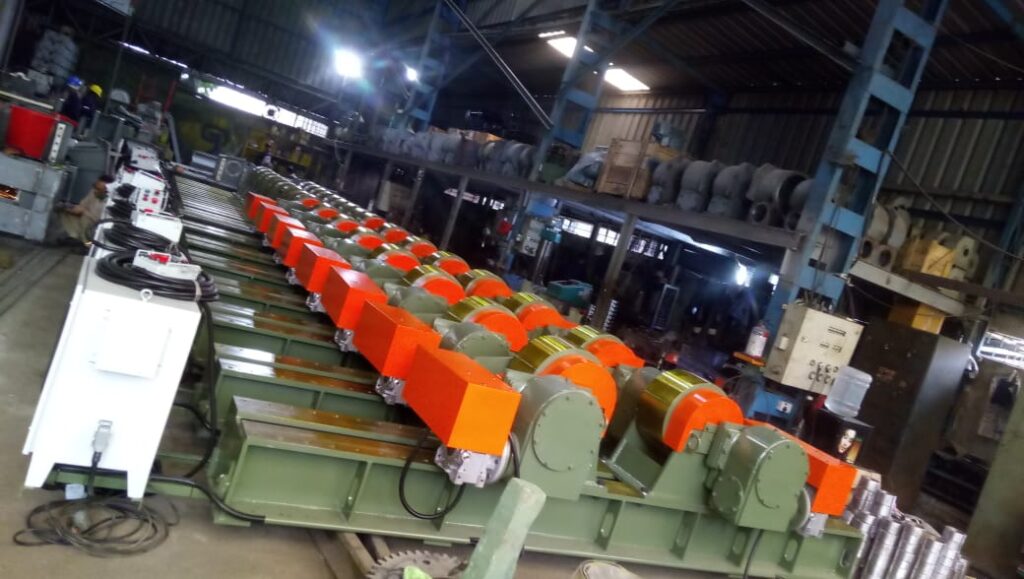
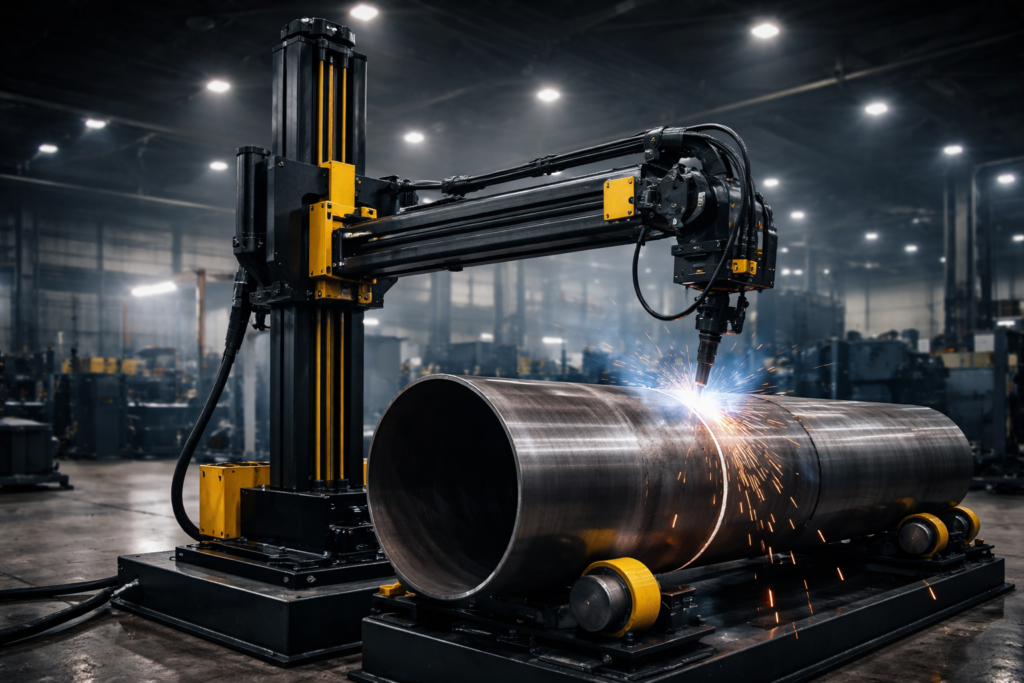
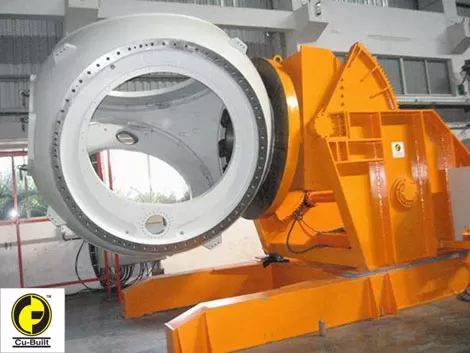
- Welding Automation Systems: Pairing overhead cranes with specialized welding positioners, rotators, and column-and-boom setups streamlines assembly, allowing operators to turn heavy pressure vessels and pipe structures safely.
To explore space-saving equipment options for tight factory spaces, review the range of Cu-Built Transfer Trolleys and Underslung Cranes.
Why Partner with Cu-Built Engineers for Industrial Overhead Lifting Solutions?
For over three decades, Cu-Built Engineers Private Limited has been a pioneer in industrial automation, heavy structural fabrication, and material handling systems. Operating out of advanced manufacturing facilities in Pune, Maharashtra, Cu-Built delivers end-to-end turnkey engineering solutions across India and international markets.
When you choose Cu-Built as your eot crane manufacturer in india, you gain access to comprehensive engineering support:
- Customized Engineering: Every crane is engineered around your facility’s exact span, hook height, structural load capacity, and duty cycle requirements.
- Rigorous Manufacturing Compliance: Designed and tested in accordance with IS 3177, IS 807, and international standards using finite element analysis (FEA).
- Turnkey Implementation: Complete end-to-end management, covering capacity planning, structural design, in-house fabrication, on-site installation, commissioning, and load testing.
- Robust After-Sales Support: Annual maintenance contracts (AMC), genuine spare parts availability, and expert technician support ensure minimal shop floor downtime.
Upgrade Your Plant’s Material Handling Infrastructure Today
Upgrading your shop floor with the right eot crane system enhances productivity, reduces material transit delays, and protects workforce safety. Whether you require a single girder crane for an assembly shop or a double girder crane for heavy industrial lifting, Cu-Built’s engineering team is ready to design the ideal solution.
Contact our application engineers today to discuss your plant layout, request a custom span calculation, or receive a free quotation.
Frequently Asked Questions (FAQs)
What is the fundamental difference between a single girder and a double girder EOT crane?
A single girder crane uses one bridge beam with an underslung hoist hanging below it, making it ideal for lighter loads (up to 20 tonnes) and shorter spans. A double girder crane uses two parallel bridge beams supporting a top-running crab trolley, offering higher load capacity (up to 500+ tonnes), greater lifting height, and maximum stability across wider spans.
Which EOT crane design provides better hook height in low headroom facilities?
Double girder cranes provide superior hook height. Because the trolley rides on top of the two girders, the load hook can be drawn up into the space between the beams. Single girder cranes carry underslung hoists that hang entirely below the main beam, which reduces vertical hook clearance.
What is the maximum lifting capacity limit for a single girder EOT crane?
Single girder cranes are typically manufactured for lifting capacities up to 20 tonnes with spans up to 20 meters. For lifting requirements exceeding 20 tonnes, double girder configurations are recommended to ensure structural rigidity and safety.
How do I calculate the required span for an EOT crane installation?
Crane span is calculated by measuring the horizontal distance between the centerlines of the two elevated runway rails running down the length of your factory bay. Facility engineering teams must factor in column clearance, side approaches, and hook travel limits when determining final span dimensions.
What safety standards govern EOT crane manufacturing in India?
Overhead cranes in India must comply with IS 3177 (code of practice for overhead traveling cranes design) and IS 807 (structural design standards for steel crane structures). Depending on client specifications, systems can also be manufactured in alignment with international CMAA, FEM, and DIN standards.