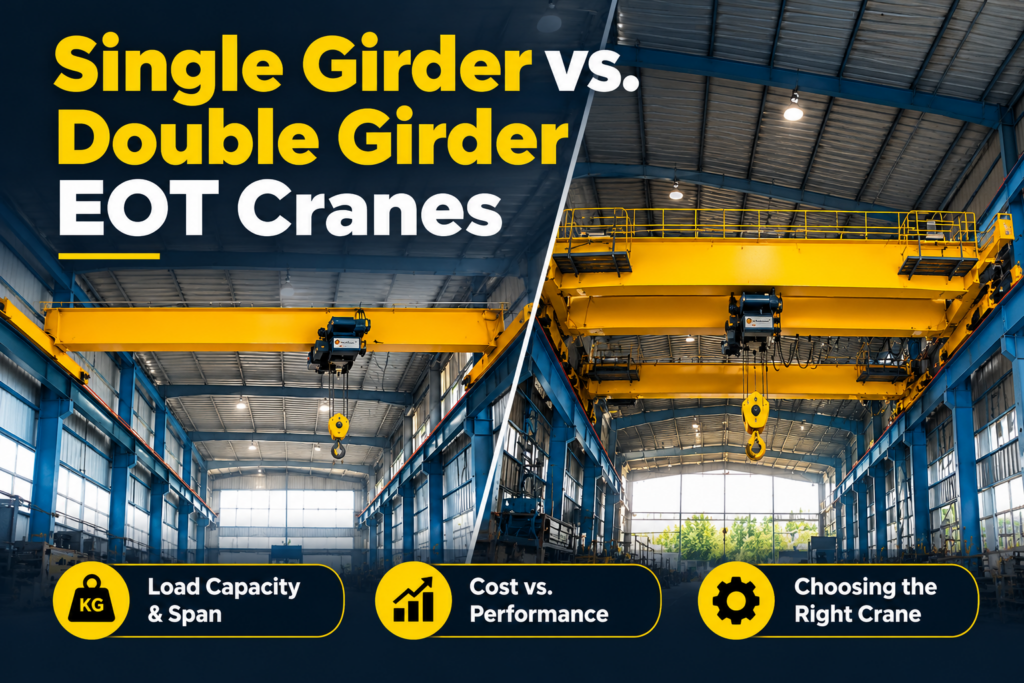
When designing or upgrading a capital-intensive manufacturing facility, selecting the correct material handling equipment is vital to long-term operational success. Among the various material handling systems available, eot cranes (Electric Overhead Traveling cranes) form the backbone of industrial logistics, heavy assembly lines, and raw material yards. Sourcing the right overhead crane requires a careful technical evaluation of your facility’s structural constraints, budget boundaries, and load capacities. Plant managers, procurement heads, and capital equipment buyers frequently face a critical choice: should they invest in a single girder configuration or a heavy-duty double girder system?
Making an incorrect choice can lead to bottlenecked workflows, excessive structural modification expenses, or premature equipment wear and tear. This comprehensive guide explores the structural nuances, load capacities, operational efficiencies, and investment considerations of single girder versus double girder eot cranes. By assessing your plant’s specific needs against engineering standards, you can secure the ideal lifting solution to maximize plant productivity and return on investment (ROI).
Understanding the Fundamentals of EOT Cranes in Industrial Sourcing
Before analyzing girder configurations, it is important to understand how modern eot cranes operate within heavy industrial environments. An Electric Overhead Traveling crane consists of parallel runways with a traveling bridge spanning the gap, carrying a motorized hoist mechanism. These systems are engineered to lift, lower, and transport heavy loads across three axes, optimizing floor space by utilizing overhead architecture.
In heavy manufacturing, steel mills, and automotive plants, material handling accounts for a significant portion of daily operational movement. Capital equipment buyers must evaluate specifications such as safe working load (SWL), span length, lifting height, duty cycle, and operating speed. Reputable manufacturers like Cu-Built Engineers design these systems adhering strictly to international and national standards such as IS 3177 and IS 807 to guarantee maximum safety and structural integrity.
Single Girder EOT Cranes: Design, Benefits, and Limitations
Single girder eot cranes feature a single main bridge girder—typically an I-beam or a fabricated box section—supported by end carriages. The hoist and trolley arrangement generally runs along the bottom flange of the main girder.
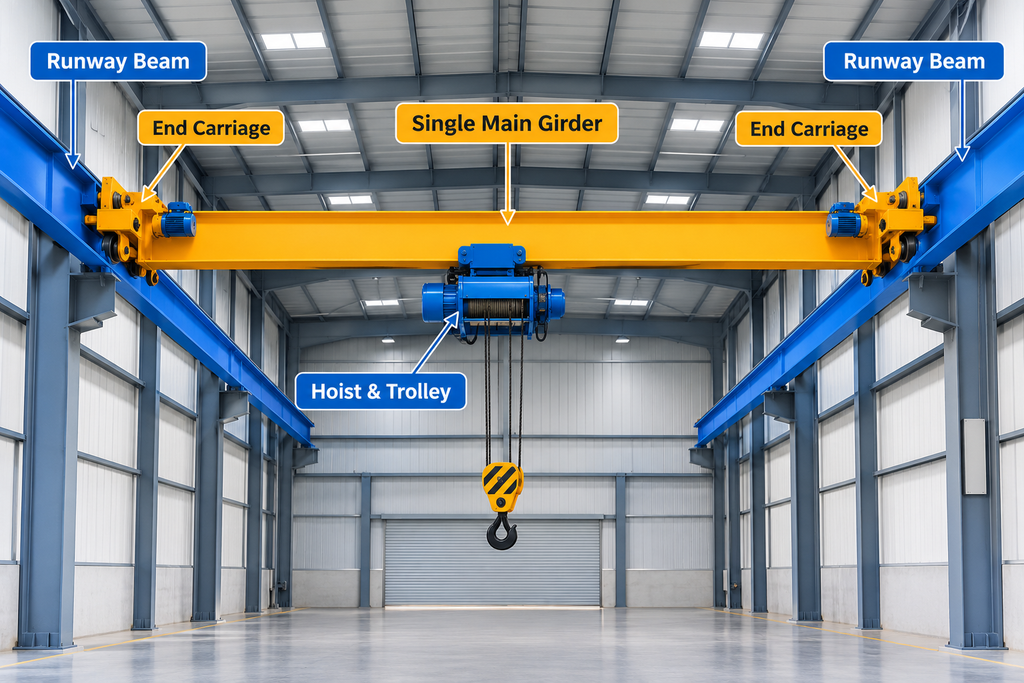
Key Technical Characteristics
- Load Capacity: Typically ranges from 1 ton up to 20 tons for standard light-to-moderate applications.
- Span Range: Most efficient for spans up to 15 to 18 meters.
- Headroom Requirements: Generally require less vertical headroom above the runway rails compared to double girder alternatives, making them ideal for restricted spaces.
Advantages of Single Girder Systems
- Cost-Effectiveness: Due to lower material usage and simpler structural configurations, single girder eot cranes feature lower initial capital expenditure (CapEx).
- Reduced Dead Weight: The lighter overall weight exerts less vertical stress on the building’s supporting columns and runway structures, potentially saving on civil engineering costs.
- Faster Installation: Simpler mechanics translate to quicker assembly, alignment, and commissioning on-site.
Limitations in Heavy Manufacturing
While highly efficient for medium-duty workshops, single girder eot cranes face limitations when handling continuous, multi-shift, ultra-heavy loads exceeding 20 tons. The eccentric loading nature of bottom-flange hoists can introduce higher rates of girder deflection under maximum loads over extended spans.
Double Girder EOT Cranes: Engineering Superiority for Heavy Lifting
For heavy manufacturing units, steel plants, and large fabrication yards, double girder eot cranes represent the gold standard of material handling resilience. These systems utilize two parallel torsion-free box girders spanning the runway, with the hoist and trolley traversing rails mounted on top of the girders.
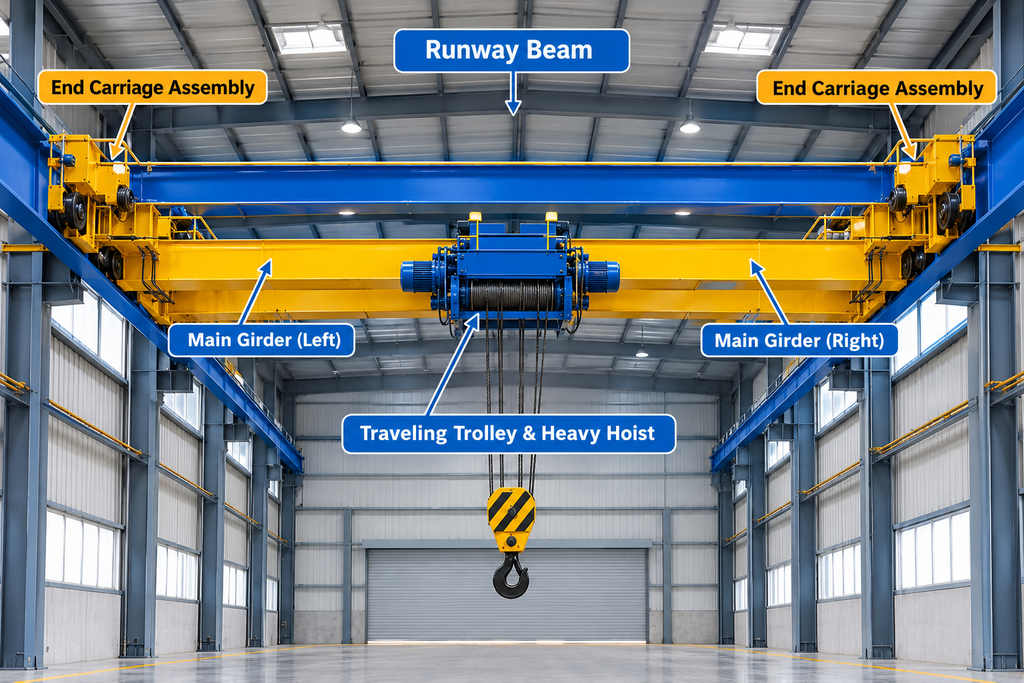
Key Technical Characteristics
- Load Capacity: Engineered to handle capacities starting from 10 tons up to 100+ tons (and custom configurations reaching 200 tons).
- Span Range: Easily accommodates wide spans exceeding 25 to 30 meters without critical deflection.
- Hook Approach: Provides superior hook height because the trolley rides on top of the bridge rails, allowing the hook to travel higher toward the building roof truss.
Advantages for Heavy Industrial Environments
- Exceptional Load Capacity and Stability: The dual-girder architecture offers superior lateral rigidity and even weight distribution, minimizing twisting forces during heavy lifts.
- Higher Duty Cycles: Built for continuous, rigorous multi-shift operations typical of heavy engineering, process industries, and bulk material yards.
- Access and Maintenance Walkways: Double girder configurations can easily accommodate full-length maintenance platforms, walkways, and cabin controls, allowing technicians to service components safely.
To explore detailed engineering configurations and specifications, you can review the technical insights provided on Cu-Built’s Double Girder EOT Cranes Page.
Comparative Matrix: Single Girder vs. Double Girder EOT Cranes
Evaluating capital equipment requires a direct comparison of operational and financial parameters. The table below outlines key differences to guide your sourcing decision:
| Parameter | Single Girder EOT Crane | Double Girder EOT Crane |
| Standard Capacity Range | 1 Ton to 20 Tons | 10 Tons to 200+ Tons |
| Maximum Span | Up to 15–18 Meters | 25 Meters to 35+ Meters |
| Hook Height / Headroom | Lower hook travel; rides on bottom flange | Maximized hook height; rides on top rails |
| Duty Class (IS/FEM) | Class II (Moderate) | Class III / IV (Heavy to Continuous) |
| Initial Investment (CapEx) | Economical / Lower Cost | Higher Initial Investment |
| Building Load Impact | Lower structural dead weight load | Higher load on columns and foundations |
| Maintenance Accessibility | Standard floor/ladder access | Walkways and service platforms integrated |
Key Engineering Factors to Consider When Sourcing EOT Cranes
When preparing a Request for Quotation (RFQ) for capital equipment procurement, plant engineers must analyze several operational variables to ensure the specified eot cranes match facility demands.
1. Duty Cycle and Classification
Crane duty classification (ranging from light assembly work to continuous heavy steel mill operations) dictates gear box selection, motor insulation classes, and brake sizing. Selecting a crane with an inadequate duty cycle results in thermal overload and excessive maintenance downtime. Modern facilities often integrate Variable Frequency Drives (VFDs) for smooth, stepless motion control, reducing mechanical shock and extending equipment life.
2. Facility Span and Runway Structure
Measure the exact bay width and evaluate the existing column load-bearing capacities. If your building columns cannot support the heavier dead weight of a double girder system, retrofitting structural reinforcement can add substantial civil costs to your project. Conversely, building a new greenfield plant allows procurement teams to specify double girder systems from the ground up to secure maximum future flexibility.
3. Safety Interlocks and Automation Features
Industrial safety regulations mandate robust protective features. When sourcing eot cranes, ensure quotes include:
- Overload protection sensors and limit switches.
- Emergency stop mechanisms and phase failure relays.
- Wireless radio remote controls alongside pendant stations for operator safety.
- Torsion-free box girder construction to eliminate structural skewing.
For broader perspectives on industrial automation standards and heavy fabrication equipment, consult industry guidelines on ThomasNet or global engineering benchmarks on Engineering360.
Streamlining Procurement: Working with Trusted Manufacturers
Sourcing heavy material handling machinery is a long-term capital investment that extends far beyond initial purchasing price. Working directly with an experienced, integrated original equipment manufacturer (OEM) ensures seamless execution across design, fabrication, shop testing, factory installation, and post-commissioning maintenance.
When evaluating potential vendor partners, verify their in-house engineering capabilities, weld inspection protocols (such as NDT testing), and compliance with statutory fabrication codes. Choosing a turnkey partner minimizes project delays, eliminates miscommunication between structural designers and electrical integrators, and guarantees reliable spare parts availability for years to come.
Optimize Your Production Floor With Custom EOT Cranes Today
Are outdated material handling systems slowing down your manufacturing throughput, creating safety bottlenecks, or driving up maintenance expenses? Upgrading to custom-engineered eot cranes tailored precisely to your bay dimensions and load profiles can transform your operational efficiency.
Partner with industry experts who understand the rigorous demands of heavy engineering. Contact Cu-Built Engineers today to discuss your project requirements, request a technical consultation, or secure a competitive quote for your next plant expansion. Let our engineering team help you build a safer, faster, and more productive shop floor.
Frequently Asked Questions (FAQs)
1. What is the main difference between single girder and double girder EOT cranes?
The primary difference lies in the bridge structure and hoist placement. A single girder crane uses one main beam with a hoist suspended underneath, suitable for lighter to moderate loads. A double girder crane uses two parallel beams with the hoist traveling on top, providing greater stability, higher lifting capacities, and longer spans.
2. What lifting capacities do single girder EOT cranes support?
Single girder eot cranes typically manage loads ranging from 1 ton up to 20 tons, making them ideal for light fabrication workshops, assembly lines, and maintenance bays.
3. When should an industrial facility choose a double girder EOT crane?
Facilities should select double girder systems when lifting loads exceeding 20 tons, operating across spans wider than 18–20 meters, or running continuous multi-shift heavy manufacturing processes (such as steel mills, heavy machinery assembly, and turbine fabrication).
4. Are VFDs necessary for modern EOT cranes?
Yes. Variable Frequency Drives (VFDs) are highly recommended because they provide smooth, stepless acceleration and deceleration, eliminate load swinging, reduce mechanical wear on brakes and gears, and enhance overall positioning precision.
5. What standards should manufacturers follow when fabricating EOT cranes?
Reputable manufacturers design and fabricate industrial overhead cranes in accordance with recognized standards such as IS 3177, IS 807, and CMAA (Crane Manufacturers Association of America) guidelines to ensure structural safety and compliance.