Introduction: The Question Every Operations Manager Is Asking in 2026
“Is welding automation worth the investment?”
It’s a fair question — especially in India, where skilled manual welders have traditionally been available, and capital expenditure decisions face intense scrutiny from finance teams.
But in 2026, the economics have shifted dramatically. Labour costs are rising. Welder shortages are real. Quality requirements from global buyers are tighter than ever. And the companies that automated their welding processes five years ago are now quoting faster, delivering cleaner work, and winning contracts that manually-operated shops can’t touch.
This article cuts through the theory and gives you real numbers, real metrics, and a practical framework to calculate whether welding automation makes financial sense for your manufacturing operation.
Spoiler: for most fabrication shops running vessel, pipe, or structural work above 2 tonnes — it almost always does.
H2: What Is Welding Automation — And What Does It Actually Include?
When most people hear “welding automation,” they think of expensive robotic arms in aerospace factories. The reality of industrial welding automation is far more accessible — and far more practical for Indian manufacturers.
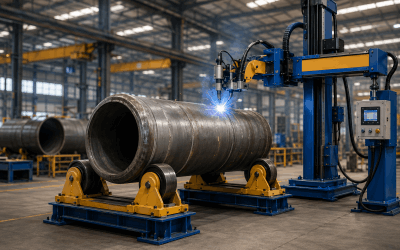
Welding automation is any system that mechanises or automates the movement of the workpiece or the welding torch (or both) during the welding process.
This includes:
| Equipment | What It Automates | Typical Application |
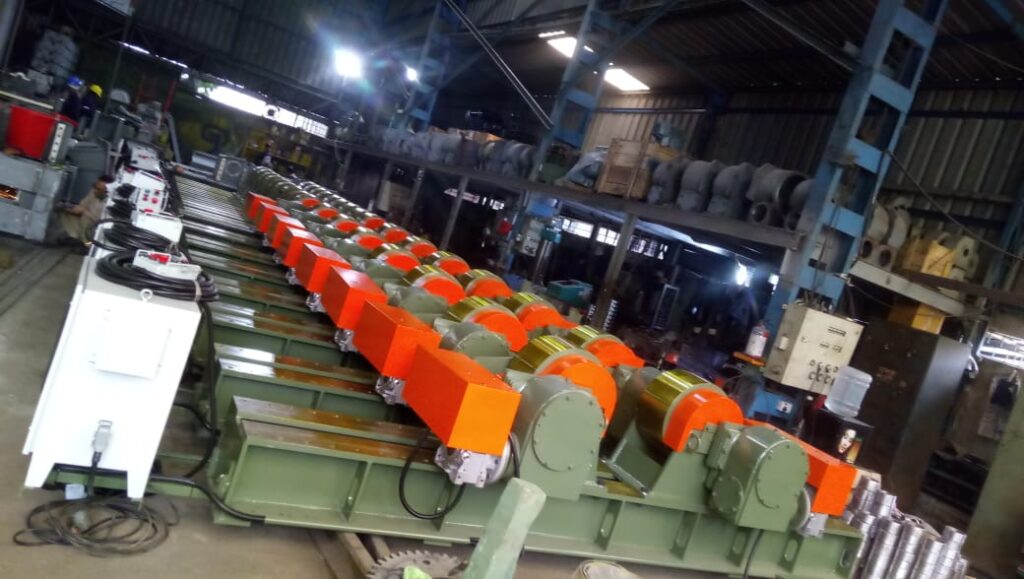
| Welding Rotators | Workpiece rotation | Vessels, tanks, pipes, towers |
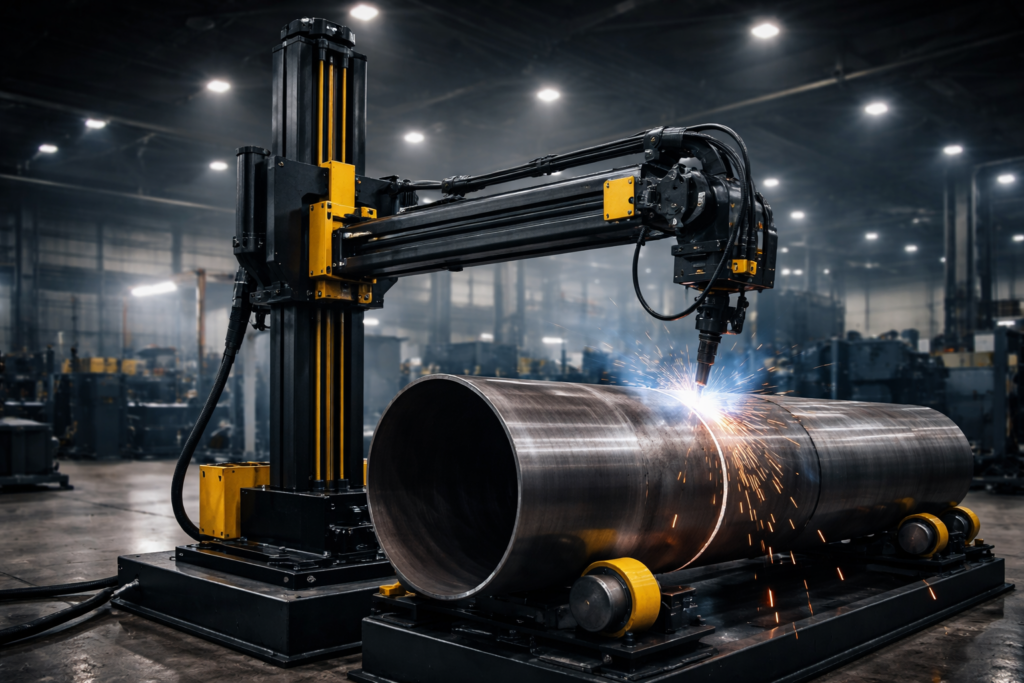
| Welding Column & Boom | Torch travel (longitudinal + vertical) | Seam welding on cylinders and tanks |
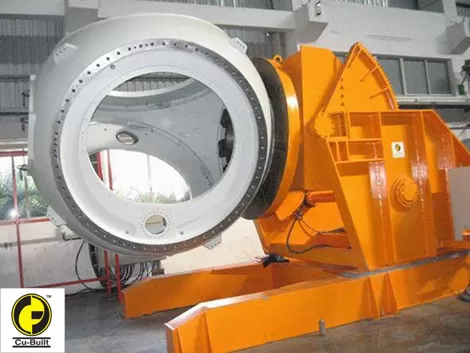
| Welding Positioners / Turntables | Workpiece tilt and rotation | Small to mid-size assemblies |
| Special Purpose Machines (SPM) | Full cycle automation | High-volume identical components |
| Head Stock & Tail Stock | Long vessel support + rotation | Wind tower cans, large boilers |
Notice that most of this equipment does not require sophisticated programming — it’s mechanical and electrical automation that any trained operator can run within days.
👉 Explore Cu-Built’s Full Welding Automation Range
H2: The Real Cost of Manual Welding — Numbers That Will Surprise You
Before calculating automation ROI, you need to understand the true cost of what you’re replacing. Most plant managers dramatically underestimate the total cost of manual positional welding.
Labour Cost Per Joint
A skilled certified welder in India currently earns ₹35,000–₹65,000 per month depending on the region and certification level. Factor in ESIC, PF, bonus, overtime, and contractor margins — the effective all-in cost is ₹55,000–₹90,000 per month per welder.
For a medium-sized vessel shop running two 8-hour shifts and 8 welders, the annual welding labour cost exceeds ₹1.2 crore — before any rework, defect, or inspection cost.
Rework and Rejection Cost
This is the hidden killer. Manual positional welding — where the welder repositions around the workpiece — creates inconsistent heat input, variable travel speed, and inconsistent wire stick-out. This leads to:
- Porosity and lack-of-fusion defects
- Undercut and overlap
- Distortion requiring post-weld straightening
Industry data from the American Welding Society indicates that rework in manual welding environments typically consumes 10–25% of total welding labour hours. In an Indian vessel shop spending ₹1.2 crore on welding labour annually, that’s ₹12–30 lakhs wasted on rework every year.
Productivity Gap
A manually-repositioned weld on a large cylindrical vessel requires the welder to stop, reposition, restart the arc, and stabilise — repeatedly through the joint. This is dead time. An automated rotator eliminates this entirely, keeping the arc burning continuously in the flat (1G) position.
Arc-on time for manual welding: typically 20–35%
Arc-on time with welding rotator + column & boom: 55–75%
That difference in arc-on time is your productivity multiplier.
H2: The ROI Calculation — A Real Scenario for an Indian Fabrication Shop
Let’s model a real example: a pressure vessel manufacturer in Pune running 10 welders across two shifts, fabricating vessels from 500mm to 2,500mm diameter in carbon steel and stainless steel.
Current State (Manual Welding)
- Annual welding labour cost: ₹1.5 crore
- Rework cost (15% of labour): ₹22.5 lakhs
- Cycle time per vessel (2T, Ø1200mm): 18 hours
- Annual output (2 shifts, 300 working days): ~320 vessels
After Automation (2× Welding Rotators + 1× Column & Boom)
- Equipment investment: ₹45–65 lakhs (depending on configuration)
- Welders required (monitoring + setup): 6 welders (from 10) — saving 4 positions
- Annual labour saving: ₹60 lakhs
- Rework reduction (from 15% to 3%): saving ₹18 lakhs/year
- Cycle time per vessel (with automation): 10–11 hours (40% faster)
- Annual output increase: ~460 vessels — a 44% throughput improvement
Payback Period
- Total annual saving (labour + rework): ₹78 lakhs
- Equipment investment: ₹55 lakhs (midpoint)
- Payback period: under 9 months
After payback, the annual net benefit continues at ₹78 lakhs — every year, indefinitely. Over a 10-year equipment life, the total net value creation exceeds ₹7 crore from a ₹55 lakh investment.
This is not an unusual scenario. According to Pemamek’s 2026 welding automation trend report, manufacturers implementing welding automation consistently achieve payback periods of 6–18 months in heavy fabrication environments.
H2: Beyond Money — The 6 Non-Financial Benefits of Welding Automation
ROI calculations capture the financial case. But experienced plant managers know that some of the most important benefits don’t show up in a spreadsheet — at least not directly.
1. Consistent, Auditable Weld Quality
Automated welding systems maintain constant travel speed, arc length, and heat input throughout the joint. For pressure vessel manufacturers working to ASME, PED, or IBR codes, this consistency significantly simplifies WPS qualification and reduces the probability of code-related failures during third-party inspection.
2. Reduced Dependence on Skilled Welder Availability
India is facing a genuine shortage of experienced certified welders — particularly for higher-code pressure equipment. Automation reduces the skill threshold required for the bulk of welding work, allowing experienced welders to focus on setup, root passes, and complex joints that genuinely need human judgement.
3. Improved Worker Safety and Health
Manual overhead and vertical welding exposes workers to prolonged arc flash, fume inhalation, and ergonomic strain. Rotator-based 1G welding keeps the weld in the flat position — reducing fume exposure, eliminating overhead welding, and dramatically improving working conditions.
4. Scalability Without Proportional Headcount Growth
With manual welding, doubling output means roughly doubling your welder headcount. With automation, you can increase output 30–50% with the same team by optimising arc-on time and parallel operations.
5. Competitive Tendering Advantage
When you can quote accurate cycle times backed by automated production, your project bids are more precise and credible. Global EPCs and OEMs increasingly require evidence of welding automation capability as a pre-qualification condition for large fabrication contracts.
6. Digital Integration Readiness
Modern welding automation systems from Cu-Built can integrate with welding data loggers and WPS monitoring systems — giving you digital records of every weld parameter for QC traceability. This is increasingly required by international clients and third-party inspection bodies.
H2: Which Welding Automation Equipment Delivers the Fastest ROI?
Not all automation investments return equally quickly. Here’s a practical ranking based on typical Indian fabrication shop scenarios:
Fastest ROI: Welding Rotators (6–12 months)
The highest-impact investment for any shop fabricating cylindrical components. Immediate productivity gain, minimal operator training, direct reduction in rework.
Cu-Built Welding Rotators — 5T to 1,000T
High ROI: Welding Column and Boom (8–14 months)
Paired with rotators, a column and boom system automates the torch carriage, eliminating manual tracking. The combination achieves maximum arc-on time and weld consistency.
Cu-Built Welding Column and Boom Systems
Strong ROI: Welding Positioners and Turntables (10–18 months)
For smaller assemblies and complex weldments, positioners reduce repositioning time and enable access to all joints without overhead welding.
Strategic ROI: Special Purpose Machines / SPMs (12–24 months)
For high-volume, identical components, a dedicated SPM automates the complete weld cycle. Higher investment, but the production economics at volume are compelling.
Cu-Built Special Purpose Welding Machines
H2: Is Your Shop Ready for Welding Automation? — A 5-Point Readiness Check
Before investing, assess your readiness honestly:
- Do you fabricate cylindrical or repetitive weldments? (Rotators deliver the most value here)
- Is your weld volume consistent enough to keep automation busy for at least 1–2 shifts per day?
- Do you have a quality problem — high rework, failed inspections, customer returns?
- Are you facing welder availability issues or significant wage inflation in your area?
- Are your customers asking for weld data, traceability, or automation evidence as part of their vendor qualification?
If you answered yes to 3 or more of these questions, welding automation will deliver measurable ROI in your operation.
H2: How Cu-Built Engineers Delivers Turnkey Welding Automation
Cu-Built Engineers does not just supply equipment — we engineer complete welding automation stations. Our turnkey approach covers:
- Application engineering and layout design
- Equipment selection and configuration
- Mechanical and electrical integration
- Commissioning and operator training
- Ongoing service and spare parts support
With manufacturing facilities across Pune (MIDC Bhosari), Satara, Karnataka, and Gujarat — and clients including Adani, Enercon, and ReNew Power — Cu-Built has the engineering depth and project experience to match the right automation to your specific production requirements.
Explore Cu-Built Turnkey Welding Solutions
Calculate Your ROI — Talk to Our Automation Engineers Today
Ready to see what welding automation could save — and earn — in your specific operation?
Cu-Built’s application team will review your current production data, identify the right automation configuration, and prepare a detailed ROI projection with realistic payback calculations.
No generic proposals. No pressure. Just real numbers for your real operation.
Request a Free Welding Automation ROI Assessment
+91 97300 89705 | 📧 sales@cubuilt.com
MIDC Bhosari, Pune, Maharashtra – 411026
Also explore: