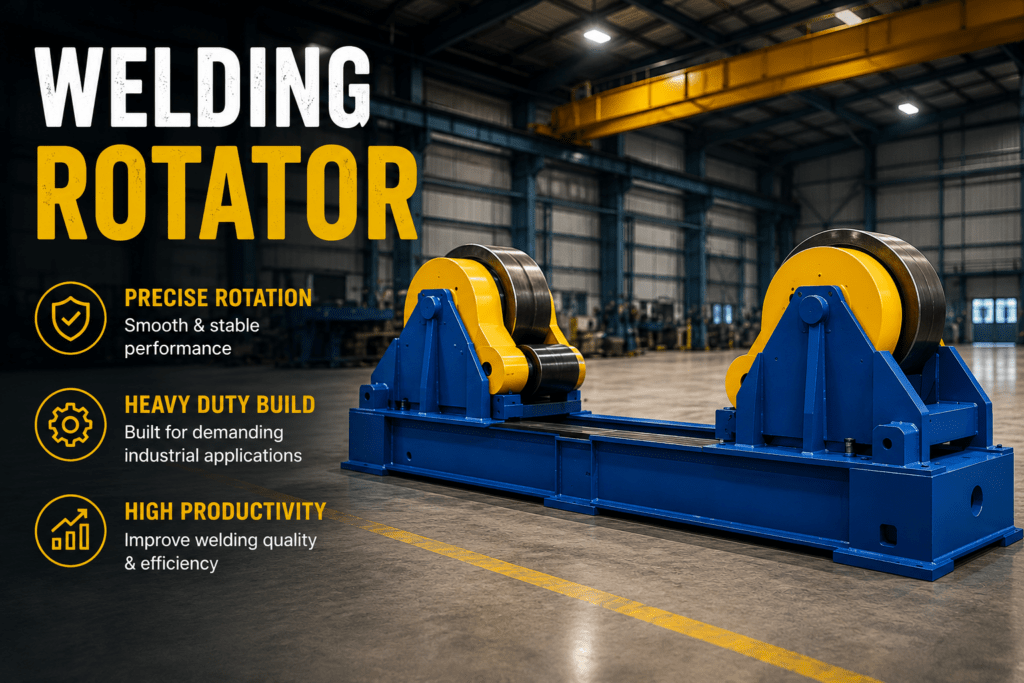
In heavy industrial manufacturing, maximizing your floor’s throughput while protecting your financial bottom line is a continuous balancing act. When dealing with circumferential joints on pressure vessels, storage tanks, or heavy-duty piping systems, automated positioning machinery becomes non-negotiable. However, structural engineers and procurement managers always face a foundational crossroad: Should you invest capital upfront to buy a machine, or should you opt for a high-quality welding rotator for hire?
Choosing between a permanent asset acquisition and a short-term equipment lease requires a deep look into project durations, available floor space, and balance-sheet mechanics. While owning machinery provides long-term production equity, choosing a specialized welding rotator for hire offers unmatched financial agility and technical adaptability for modern engineering firms.
This strategic analysis breaks down the commercial indicators, operational realities, and financial trade-offs of the buy-versus-rent dilemma. By assessing these factors, your facility can choose the most profitable path forward for your cylindrical fabrication pipelines.
1. CAPEX vs OPEX: The Financial Mechanics of Fabrication Equipment
The primary differentiator between purchasing heavy engineering assets and securing a welding rotator rental lies in how the expense impacts your company’s financial records.
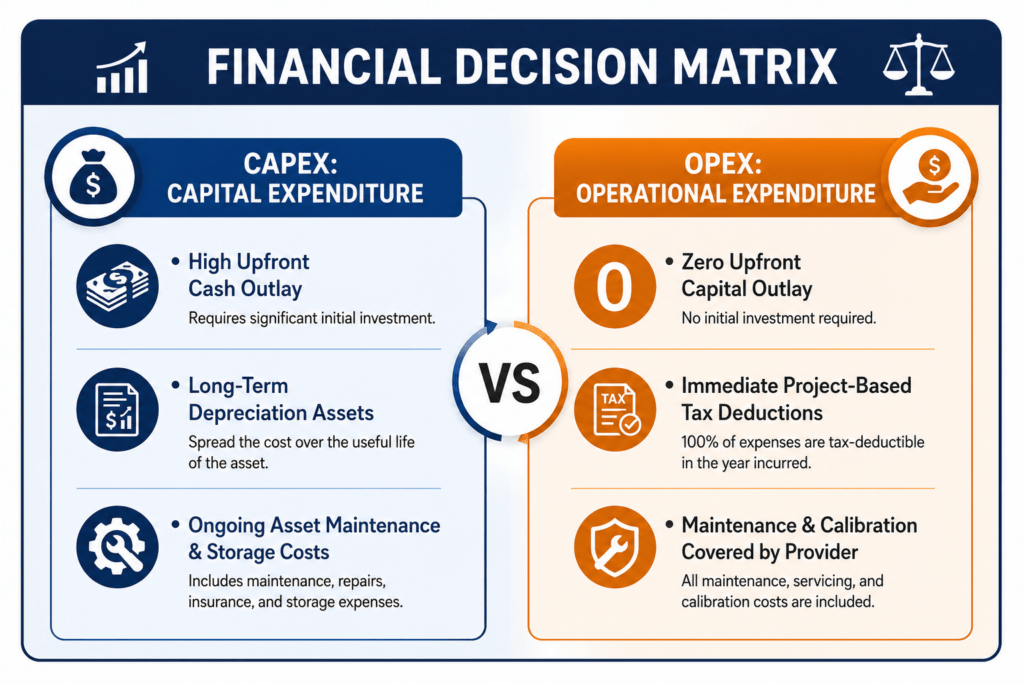
Capital Expenditures (CAPEX) and Depreciation
Buying heavy-duty automation machinery represents a Capital Expenditure. The equipment is recorded as a long-term asset on your balance sheet and depreciates over several years. This ties up substantial upfront cash flow that could otherwise be spent on raw materials, facility expansions, or hiring skilled labor.
Beyond the initial purchase price, ownership introduces secondary, ongoing costs:
- Specialized maintenance schedules
- Component replacement (such as refurbishing polyurethane or steel wheels)
- Third-party safety certifications
- Dedicated indoor warehouse space when the machine is idle
Operating Expenditures (OPEX) and Strategic Cost Allocation
Choosing a welding rotator on rent shifts the procurement model to an Operating Expenditure (OPEX). Instead of taking on a large fixed liability, your company incurs a variable cost directly tied to a specific project.
This model introduces distinct financial advantages for your balance sheet:
- Tax Deductions: OPEX rental fees are generally fully deductible as direct operating costs within the same fiscal year, reducing your overall corporate tax liability.
- Preserved Cash Flow: Avoiding large cash down payments keeps your working capital liquid, leaving your business better equipped to handle market changes or supply chain fluctuations.
- Clear Cost Tracking: Equipment rental rates can be factored straight into your project’s bill of materials (BOM), ensuring precise profit margin calculations before work even begins.
When comparing capex vs opex fabrication equipment, procurement teams must look past the base daily or monthly rental rate. You should carefully weigh the total cost of ownership (TCO) against the flexible, all-inclusive nature of a professional equipment rental agreement.
2. Project Duration and Lifecycle Assessment
The definitive metric for choosing whether to purchase or choose a welding rotator for hire is your project timeline and equipment utilization rate.
Short-Term and Surge Capacity Needs
If an incoming fabrication contract has a defined timeline—such as three to nine months—purchasing highly specific automation machinery rarely makes financial sense. Taking a short term welding equipment rental approach allows a shop to scale its production capacity to meet peak demands without committing to the hardware long-term.
This approach is highly effective for:
- Fast-track infrastructure upgrades
- Emergency plant shutdowns or turnaround maintenance contracts
- One-off specialized builds requiring load capacities beyond your current shop limits
Calculating Your True Utilization Rate
A reliable rule of thumb for engineering workshops is the 60% utilization threshold. If an automated asset sits idle in your facility for more than 40% of the working year, the cost of storing, insuring, and maintaining it begins to eat away at your initial ROI.
By utilizing a project-based procurement model, you convert fixed overhead into a flexible cost. The machine arrives exactly when your project starts and is returned the moment the final circumferential seam passes inspection, ensuring you never pay for idle floor space.
3. Technology Obsolescence and Specialized Job Profiles
Industrial automation technology moves quickly. A turning roll system bought today might lack the precise control integration, variable frequency drive (VFD) stability, or automated self-alignment capabilities required by complex structural designs years down the road.
Accessing Advanced Automation Without the Risk
Opting for a welding rotator for hire gives your shop immediate access to modern machinery without the risk of technology obsolescence. Professional fleet hire providers continuously update their stock with advanced systems, including:
- High-torque AC motor configurations with precise VFD speed regulation
- Multi-stage, self-locking gear reductions for precise rotation control
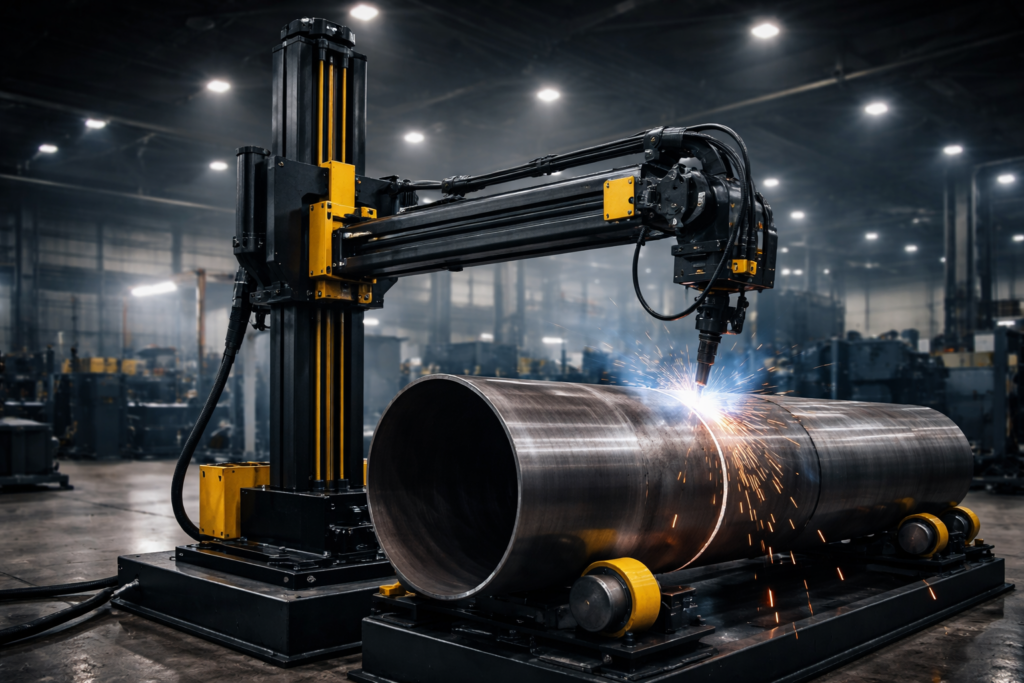
- Advanced synchronized tracking systems designed to work alongside automated Column and Boom assemblies
Matching the Rotator to Changing Material Geometries
Different jobs require highly specific engineering features:
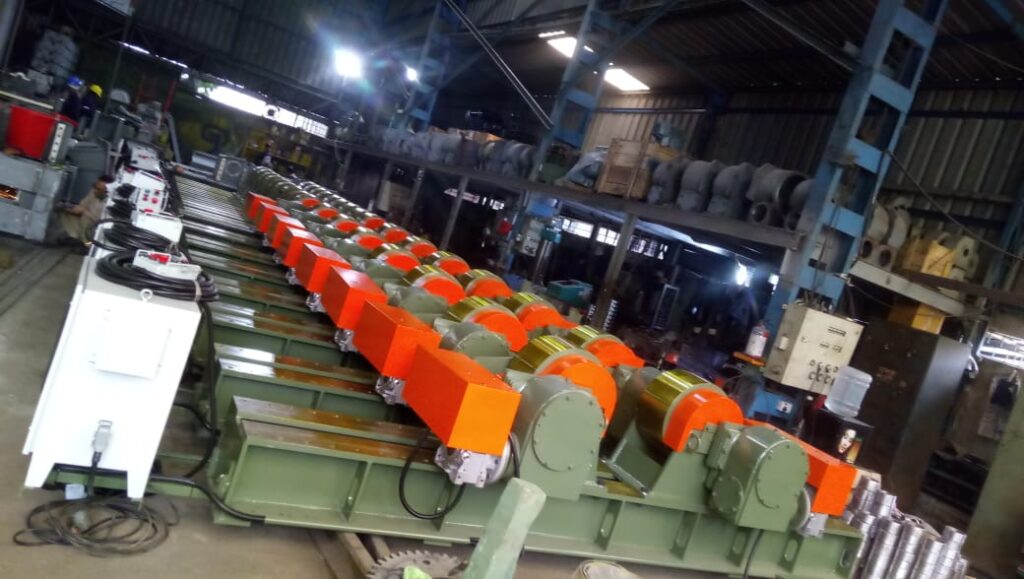
- Thin-Walled Cylindrical Shells: These workpieces are prone to localized deformation. They require a specialized Self Aligning Type Welding Rotator that uses a four-point contact layout to distribute weight evenly across the shell’s surface.
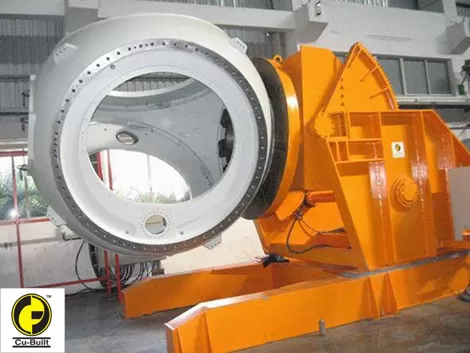
- Heavy, Fixed-Diameter Monopiles: These demand the extreme rigidity of conventional, bolt-adjusted heavy-duty turning rolls.
- Small-Diameter Process Piping: These assemblies require a dedicated pipe welding rotator hire equipped with non-marking polyurethane rollers to protect sensitive alloys from carbon contamination.
If your workshop relies entirely on owned assets, you may find yourself forced to modify your processes to fit your existing machines. Renting ensures you can select the exact machine geometry required for every specific job profile.
4. The Hidden Costs of Asset Ownership
The true expense of owning a heavy positioning asset goes far beyond its initial factory invoice. Operational overhead can quickly erode the projected savings of a purchase.
Storage, Transport, and Floor Space Management
A 50-ton or 100-ton turning roll setup takes up considerable square footage. When an owned asset is not in use, it takes up high-value real estate on your shop floor that could otherwise be used for active manual assembly, fit-up stations, or material storage. Furthermore, moving heavy equipment between different regional branches or project sites involves high logistics costs, heavy rigging fees, and complex transport permits.
Maintenance, Calibration, and Compliance Costs
To deliver structural welds that meet stringent code standards (such as ASME Section VIII or ISO 3834), turning roll systems must provide smooth, vibration-free rotation. This requires continuous maintenance:
- Regular gearbox oil changes and bearing greasing
- Drive system calibrations to prevent rotation stalling or speed variations
- Wheel inspections to replace worn or delaminated roller surfaces
When you choose a professional welding rotator for hire, the burden of preventative maintenance, component wear, and certified safety inspections shifts entirely to the equipment provider. Your team receives a fully serviced, production-ready machine backed by field support, minimizing the risk of unexpected downtime during critical project phases.
5. Overcoming Supply Chain Bottlenecks and Lead Times
In the competitive fabrication landscape, winning a lucrative contract often depends on how quickly you can mobilize your workforce and start production.
The Long Road of Capital Procurement
Purchasing a brand-new, high-capacity turning roll directly from an OEM usually involves long lead times. Engineering design reviews, component sourcing, factory assembly, and international shipping can delay delivery by several months. If your project has a strict deadline, waiting on equipment delivery can lead to costly project delays or missed contract opportunities.
Quick Deployment with Temporary Equipment Setups
Securing a welding rotator lease India or tapping into a regional rental fleet provides an immediate solution. Establishing a temporary fabrication setup with hired machinery allows you to set up high-output production lines in just days rather than months. This rapid response capability allows your shop to take on urgent, high-value projects, maximize your market agility, and build a reputation for fast, reliable delivery.
Buy vs Rent Checklist for Engineering Managers
To help simplify your procurement strategy, use this quick checklist to guide your decision:
| Evaluation Factor | Choose a Welding Rotator Hire | Purchase a Permanent Asset |
| Project Horizon | Fixed-term contracts (under 12 months) | Continuous production (multi-year outlook) |
| Asset Utilization | Estimated to be below 60% annually | Steady, predictable daily operation |
| Financial Goal | Preserve liquid cash, maximize OPEX tax deductions | Long-term asset capitalization, available cash reserves |
| Material Variation | Changing workpiece diameters, weights, and alloys | Standardized product lines with uniform geometries |
| Maintenance Capacity | Lean workshop staff focused purely on fabrication | In-house mechanical maintenance team available |
Industrial Automation Solutions by Cu-Built Engineers
For operations aiming to achieve flawless circumferential welds while maintaining strict control over project overhead, partner with a trusted industrial manufacturer like Cu-Built Engineers.
As a leading developer of heavy-duty industrial automation systems, Cu-Built designs and builds top-tier Welding Rotators engineered for exceptional reliability, smooth VFD speed control, and rugged durability under tough workshop conditions. Whether you are looking to build out your permanent fleet with customized heavy-duty machinery or looking to optimize your project-based procurement strategy, our engineering team provides high-performance hardware designed to cut down-time and maximize your deposition rates.
Questions & Answers
Q1: Can a rented welding rotator be safely integrated with our existing automated welding systems?
Yes. High-quality hired welding rotators feature adaptable control panels equipped with standard interface connections. This allows them to integrate smoothly with existing automated welding equipment, including column and boom systems, automatic sub-arc (SAW) systems, or specialized MIG/TIG setups. This compatibility ensures consistent, synchronized rotation speeds that match your precise welding parameters.
Q2: What roller surface material should we choose when hiring a rotator for stainless steel pipe projects?
For stainless steel, duplex, or other non-ferrous alloys, always choose a pipe welding rotator hire equipped with high-traction polyurethane (PU) or vulcanized rubber rollers. Avoid solid steel wheels, as they can cause surface marking and carbon contamination, which compromises the corrosion resistance of exotic metals and can lead to costly quality control failures.
Q3: How do we determine the correct load capacity when setting up a temporary fabrication setup?
Always calculate the total weight of your heaviest workpiece, including internal baffles, nozzles, and attached fittings. Ensure that the combined load capacity of the driver and idler units comfortably exceeds this maximum weight. For long or asymmetrical cylindrical vessels, consider adding extra idler units to prevent structural sagging and ensure smooth, balanced rotation.
For further reading on industrial safety standards and structural welding regulations, consult the American Welding Society (AWS) and the International Organization for Standardization (ISO) guidelines.