Introduction: The Most Common Crane Selection Mistake in Indian Industry
Walk into any manufacturing plant, fabrication yard, or warehouse in India and you will almost certainly find an overhead crane of some kind. And far too often, you will also find the wrong crane for the job — either an EOT crane installed in an outdoor yard where it struggles with environmental exposure, or a gantry crane bolted into a building where it unnecessarily increases structural costs.
The difference between an EOT (Electric Overhead Travelling) Crane and a Gantry Crane goes far deeper than how they look. It affects your civil structure requirements, your operating costs, your maintenance burden, and your production capacity for the next 20 years.
This guide gives you a clear, no-nonsense comparison — so you walk away knowing exactly which crane type fits your facility, your budget, and your operational needs.
What Is an EOT Crane?
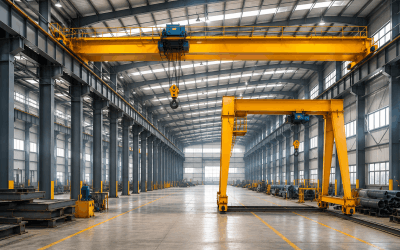
An EOT Crane (Electric Overhead Travelling Crane) is a fixed overhead crane where the bridge girder is supported by rails mounted on runway beams attached to the building’s structural columns. The crane travels along these elevated rails, covering the full length of the bay.
EOT cranes are the backbone of Indian manufacturing — found in steel plants, automobile factories, engineering shops, power plants, and heavy fabrication units across the country.
Key Components of an EOT Crane:
- Bridge girder (single or double) spanning the bay width
- End carriages running on elevated runway rails
- Crab unit (cross-travel trolley carrying the hoist)
- Electric hoist (wire rope or chain)
- Control system (pendant, remote, or cabin)
EOT cranes are manufactured to IS 807 and IS 3177 standards in India, which define design loads, duty classifications (M1 to M8), and safety requirements.
�� Explore Cu-Built’s Full EOT Crane Range
What Is a Gantry Crane (Goliath Crane)?
A Gantry Crane (also called a Goliath Crane) is a crane where the bridge girder is supported by free-standing A-frame legs that travel along ground-level rails. It does not require any building runway structure — the crane is self-supporting.
A Semi-Gantry Crane is a hybrid: one side runs on ground rails while the other side is supported on a building column runway — useful when you need outdoor reach on one side and indoor coverage on the other.
Gantry cranes are essential in open fabrication yards, shipyards, rail infrastructure projects, precast concrete plants, and wind tower manufacturing facilities — anywhere a building structure either doesn’t exist or can’t support overhead rail loads.
�� See Cu-Built’s Gantry and Goliath Crane Range
EOT Crane vs Gantry Crane — The Complete Head-to-Head Comparison
| Comparison Factor | EOT Crane | Gantry / Goliath Crane |
| Support structure | Building runway beams & columns | Free-standing A-frame legs on ground rails |
| Best environment | Enclosed factory / workshop | Open yard, outdoor facilities, large sheds |
| Civil requirement | High — building must be designed/rated for crane loads | Moderate — only ground rail foundations required |
| Span range | 5m to 30m+ | 10m to 80m+ |
| Capacity range | 1T to 500T | 10T to 1,000T+ |
| Installation cost | Lower if building already exists | Higher upfront (legs + ground rails), but no building load |
| Operational flexibility | Fixed to building bay | Can span areas outside any building |
| Maintenance access | Easier (fixed height) | More complex (tall structures) |
| Indoor/Outdoor | Primarily indoor | Both indoor and outdoor |
| Typical industries | Manufacturing, auto, steel, pharma | Shipbuilding, wind towers, EPC yards, precast |
Deep Dive — EOT Crane Types and When to Choose Each
Single Girder EOT Crane
Uses one main bridge beam supported at each end by end carriages. The hoist hangs below the girder on an underslung trolley.
Choose single girder when:
- Lifting capacity is up to 20 tonnes
- Bay span is up to 20 metres
- Headroom is limited (the hoist hangs lower than double girder)
- Budget is a key factor — single girder is 20–30% less expensive
Best industries: General engineering, light manufacturing, warehouses, workshops
�� Cu-Built Single Girder EOT Cranes
Double Girder EOT Crane
Uses two parallel bridge beams with the crab trolley running on top rails between them. This provides significantly greater structural rigidity, higher hook height, and higher duty cycle capability.
Choose double girder when:
- Lifting capacity exceeds 20 tonnes (standard choice up to 500T+)
- Precise load positioning is required
- High duty cycles (continuous production environments)
- Integration with magnet, grab, or ladle is required
- Maximum hook height is critical
Best industries: Steel plants, heavy fabrication, automotive assembly, power generation, oil & gas
�� Cu-Built Double Girder EOT Cranes
Deep Dive — Gantry Crane Types and When to Choose Each
Double Girder Goliath Crane
The heaviest-duty gantry configuration — two bridge girders spanning between two tall A-frame leg assemblies. Capable of lifting the most massive loads over the widest spans.
Choose when: Wind tower section handling, large vessel lifts, ship section assembly, precast yard stacking
Capacity: Up to 1,000 tonnes and beyond for special applications
�� Cu-Built Double Girder Goliath Cranes
Single Girder Goliath Crane
One bridge girder on A-frame legs. More economical than the double girder version for mid-range capacities in semi-open or outdoor environments.
Choose when: Fabrication yards up to 100 tonnes, rail and infrastructure projects, material staging areas
Semi-Goliath Crane
One leg runs on a ground rail; the other side hooks onto an existing building runway. This is the most cost-effective solution when you need to extend coverage from inside a building into an adjacent outdoor area.
Choose when: Existing factory with outdoor extension yard, EPC contractors needing flexible coverage
�� Cu-Built Semi-Goliath Cranes
Crane Safety Standards You Must Know Before Buying
Whether you choose an EOT crane or a gantry crane, Indian safety regulations and international standards mandate specific design, installation, and inspection requirements:
- IS 807:2006 — Code of practice for design, manufacture, erection, and testing of cranes and hoists
- IS 3177:1999 — Electric overhead travelling cranes and gantry cranes
- Factory Act 1948, Section 28 — Hoisting machinery requirements in Indian factories
- OSHA 1910.179 — Overhead and gantry crane standards (applicable for export and multinational facilities)
Cu-Built cranes are designed and manufactured in compliance with IS standards and customer-specified international codes (FEM, DIN, AS standards available on request).
Real Industry Applications — Which Companies Use Which Crane
Heavy Fabrication & Wind Tower Manufacturing
Wind tower plants require the movement of shell sections weighing 30–100 tonnes over large outdoor yards. Goliath gantry cranes with spans of 20–40m are the standard choice. Cu-Built has supplied gantry cranes to wind energy clients including Enercon and Ayana.
Automotive Assembly Plants
Assembly lines use double girder EOT cranes for engine block handling, body-in-white movement, and tooling changes. Typical capacity: 5T to 50T with M5/M6 duty class for high cycle rates.
Oil & Gas Fabrication Yards
EPC contractors running open-air pipe spool and pressure vessel fabrication yards use semi-goliath or full goliath cranes for heavy lifts combined with EOT cranes in covered fabrication bays.
Steel Melting Shops
Double girder EOT cranes with ladle attachments are essential — duty class M7 or M8 for continuous operation, with anti-sway and precision positioning systems.
Infrastructure and Construction Precast Plants
Gantry cranes with large spans handle precast beam and slab stacking — outdoor environment, ground-level rail operation.
Total Cost of Ownership — EOT Crane vs Gantry Crane
The purchase price is only a fraction of the real cost. Here’s what experienced plant engineers factor in:
EOT Crane — Cost Considerations:
- If the building is new, civil design must account for crane runway loads from day one (adds 10–20% to structural cost)
- Lower maintenance cost — simpler structure
- Longer lifespan in protected indoor environment (20–30 years)
- Energy efficient with modern VFD drives
Gantry Crane — Cost Considerations:
- Higher initial cost for leg fabrication and ground rail foundations
- Higher maintenance exposure in outdoor environments (corrosion, wind loading)
- No building load requirement — ideal when structure is not planned
- Spans can be extended or relocated as the facility grows
The rule of thumb: If you have (or are building) an enclosed facility — EOT crane. If your primary working area is open or semi-open — gantry crane.
5 Questions to Ask Before You Finalize Your Crane Order
- Is my primary working area enclosed, semi-open, or fully outdoor?
- What is the maximum single lift weight I will ever need — not today, but in 5 years?
- What duty class is required? (light workshop vs continuous shift production)
- Do I need precise positioning, anti-sway, or load monitoring integration?
- Is my building structure already rated for runway beam loads?
These five questions, answered honestly, will determine your crane type in under 10 minutes.
Why Industry Leaders Choose Cu-Built for Overhead Cranes
Cu-Built Engineers designs, manufactures, supplies, and erects EOT cranes and gantry cranes from facilities in Pune (MIDC Bhosari), Satara, Karnataka, and Gujarat. Every crane is backed by in-house structural design, electrical engineering, quality inspection, and after-sales service.
- ✅ Single girder EOT cranes — 1T to 20T
- ✅ Double girder EOT cranes — 5T to 500T
- ✅ Semi-goliath, single, and double girder goliath cranes
- ✅ Jib cranes for workstation lifting
- ✅ Wall traveling cranes for bay supplements
- ✅ IS, FEM, and DIN standard compliance
�� Explore All Crane Products at Cu-Built
Get the Right Crane for Your Facility — Free Consultation in 48 Hours
Stop guessing. Talk to Cu-Built’s application engineering team and get a technical recommendation, load calculation review, and quotation based on your exact facility layout and production requirements.
No commitment. No generic catalog. Just the right answer for your application.
�� Request a Free Crane Selection Consultation
�� +91 97300 89705 | �� sales@cubuilt.com
�� Plot No. 149, Sector 10, MIDC Bhosari, Pune – 411026
Also explore: